
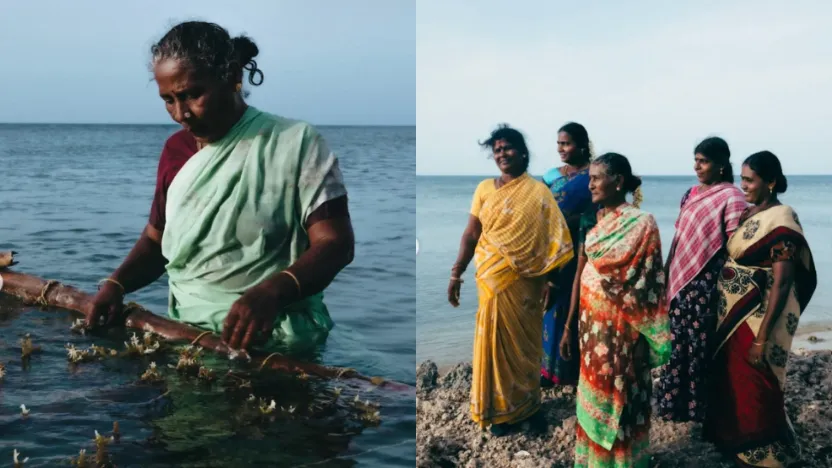
Before the sun rises and while much of the world is still tucked comfortably under blankets, a group of women in Rameswaram, India, prepares for another day at work.
Dressed in sarees instead of diving suits, they make their way towards the sea. With basic diving masks, simple hand protection and plastic sacks tied around their waists, they enter the water, take a deep breath and disappear beneath the waves.
Their mission? To harvest seaweed from underwater rocks and dead coral reefs near the islands of the Gulf of Mannar. It may seem like an ordinary livelihood to some, but for these women, every dive represents years of determination, inherited knowledge and the responsibility of keeping their families fed.
Meet the saree-clad seaweed harvesters of Rameswaram, whose remarkable resilience and contribution often go unnoticed.
For many of these women, seaweed harvesting is more than just a profession. It is a tradition passed down through generations. According to The Better India, the skills involved in collecting seaweed have been inherited from their mothers, grandmothers and great-grandmothers, who spent years working in the same waters.
Without specialised diving equipment, these women rely on techniques they have learned over the years. They collect seaweed growing on underwater rocks and coral formations, often protecting their fingers by wrapping them in pieces of cloth secured with rubber bands.
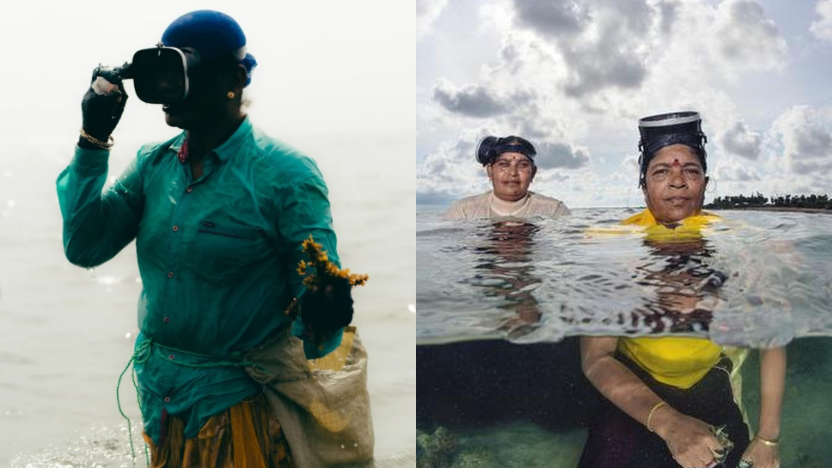
Their simple equipment reflects the limited resources available to them, but their ability to work beneath the water demonstrates remarkable skill and familiarity with the sea. Despite facing poverty, the aftermath of a devastating tsunami and restrictions on seaweed collection, these women continue to depend on the ocean for their livelihoods.
They are also regarded as important guardians of the Gulf of Mannar's marine environment, where their traditional knowledge has developed through generations of working closely with the sea. Behind their determination lies a challenging reality.
Despite spending hours in the water, many of these women lack proper protective equipment, adequate facilities and access to essential healthcare. According to Mongabay India, women from several coastal villages continue to depend on seaweed harvesting as their primary source of income. Armed with little more than basic diving masks and plastic sacks, they venture into the sea despite the risks involved.
Their work exposes them to unpredictable weather, changing sea conditions and potential injuries, while access to nearby medical facilities remains limited. For these women, however, staying on land is not always an option when their families depend on the income they earn from the sea.
Lakshmi Moorthy, a 48-year-old resident of Chinnapalam village who has been harvesting seaweed since she was seven, expressed just how essential the work is to her family's survival.
"My family cannot eat if I do not go to the sea," she said, as quoted by The Better India.
Her words reflect the reality faced by countless women whose daily struggles rarely receive the recognition they deserve. Their lives might have remained largely unseen if not for photographer Raajadharshini, who discovered their story quite unexpectedly.
According to WePresent, she first came across the community through a newspaper clipping that had been used to wrap her food. What began as a chance discovery eventually inspired her to document the lives of these women and bring their experiences to a wider audience.
Through her photography, she hopes to highlight not only their remarkable determination but also their urgent need for better protective equipment and working conditions, particularly as climate change makes weather patterns and sea conditions increasingly unpredictable.
Her observations also reveal another side of their lives. Beyond the physical demands and uncertainties of their work, it is the moments of laughter, friendship and togetherness that help these women persevere through difficult circumstances.
Their stories are not defined by hardship alone, but also by the strength of a community that continues to stand together. The challenges faced by these women are also closely connected to environmental conservation policies.
The Gulf of Mannar was declared a Marine National Park in 1986 to protect its rich marine biodiversity, including coral reefs and endangered species such as dugongs. Following the designation, restrictions were introduced on activities such as seaweed collection around protected islands, affecting coastal communities that had traditionally depended on these waters for their livelihoods. According to The Better India, these restrictions have had a significant impact on families who rely on seaweed harvesting as a source of income.
For women who have spent most of their lives working in the sea, balancing environmental conservation with their right to earn a living remains an important challenge. Their experiences highlight the need for sustainable solutions that protect marine ecosystems while also considering the economic realities of coastal communities.
While these women work tirelessly to harvest it, seaweed itself plays a much bigger role in the global economy than many people realise. Unlike many land-based crops, seaweeds are rich in essential nutrients, including vitamins, minerals, proteins, healthy fats, enzymes and natural plant compounds.
According to research published in the International Journal of Pharmacy and Pharmaceutical Sciences, seaweed has long been used in various industries, including food production, animal feed, medicine, cosmetics, fuel and agriculture. It is also an important industrial resource, with extracts such as agar and alginate used in the production of numerous everyday products.
In recent years, seaweed has also gained attention in animal nutrition, particularly poultry farming, while researchers have explored its potential in wastewater treatment through its ability to absorb excess nutrients such as nitrogen and phosphorus.
Yet, behind this valuable natural resource is a community of women whose contribution often goes unnoticed. For these women, the sea is more than a beautiful landscape or a source of natural resources. It is their workplace, their livelihood and, for many families, their only means of survival.
Every morning, they return to the water, carrying generations of knowledge and the responsibility of providing for those waiting for them at home.
They may not have specialised diving suits, advanced equipment or the recognition that their work deserves, but their courage and determination speak volumes.
Source : timesofindia.indiatimes , The Hindu
Photo: UMEED MISTRY | Originally produced for the book 'Knowing The Palk Bay', a Dakshin Foundation Publication , indiaculturalhub
You may be interested in

Royal Heritage Embroidered Anarkali Gown for Women | Premium Festive Wear by RANGOLI BAZAAR

Indian Wedding Forehead Netti Pattam & Hand Wrist Pattam Gold Plated Traditional Bridal Ceremony Set

Ready stock lotus design indian saree
Ethnic Retro Corful Peacock Jhumka Earrings Womens Indian Jewelry Flower Gold Bell Tassel White Pearl Earrings