


Emily Koshy, a remarkable figure in Malaysia’s history, recognised as the nation’s first Indian policewoman at a time when the uniform was rarely worn by women, let alone those breaking both gender and societal boundaries.
“Memory works in curious ways,” she says softly, her voice still carrying the grace of her Carnatic training. “But some things… they stay.”
As the nation marks Police Day, stories like hers remind us that service is not just a profession, it is a lifelong calling.
Long before uniforms became more inclusive, before women found their place across every rank and role, Emily Koshy stood among the first seven policewomen in Malaya. It was a time when courage looked different, when stepping into such a role meant stepping into uncertainty, criticism, and quiet resistance.
"They scolded my father,” she recalls with a gentle laugh. “They told him he was making a mistake sending his only daughter into the police.”
But her father saw something others did not.
“He believed I could do it,” she says simply. “He knew my character.”
That belief would shape the course of her life.
She did not begin with a dream of becoming a police officer. Like many young women of her time, she had hoped to continue her studies. But life had other plans, and she chose responsibility over comfort. When an opportunity appeared, she stepped forward not knowing that she was about to become part of history.
“I just thought… let me try,” she says.
What followed was a journey defined not by ease, but by resilience.
She entered the force during the height of the Malayan Emergency, a period marked by fear, instability, and constant tension. While others hesitated, she trained, learned, and adapted. There was no special treatment. No softened expectations.
“We were treated the same as the men,” she recalls. “We had to prove ourselves.”
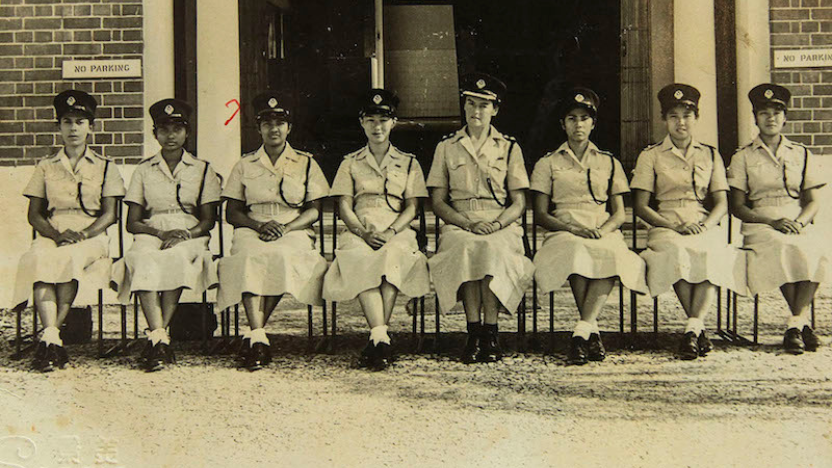
And she did.
From early morning drills to handling weapons and investigating cases, she embraced every challenge placed before her. But it was in her work with women and children that her strength truly revealed itself.
“Some of the cases were very painful,” she says quietly. “You cannot be weak when people come to you for justice.”
Her approach was firm, sometimes feared, but always grounded in integrity.
“I didn’t like bullies,” she says, her voice carrying a quiet steel. “If someone was wrong, I would not stay silent.”
In a time when corruption could easily blur lines, she chose a different path.
“You must be clean,” she says. “If you are not honest, then what is the point of wearing the uniform?”
That unwavering honesty would eventually lead her to rise through the ranks, becoming a deputy superintendent of police, a rare achievement for a woman in her era.
Yet, beyond the uniform, there was also a life built on love and partnership.
Her marriage, she shares, was not immediate affection, but something that grew with time.
“I wasn’t so keen at first,” she admits with a smile. “But he was patient.”
Her husband became her pillar, quietly supporting her demanding career while raising their children.
“For this kind of work, you need someone strong beside you,” she reflects. “He gave me that strength.”
Years passed. Stations changed. Responsibilities grew. From Muar to Melaka, and eventually to Bukit Aman, her journey became one of quiet excellence, never seeking recognition, but earning it nonetheless.
One of her proudest moments came on Aug 31, 1957, when she led the platoon of female officers during Malaya’s independence parade.
“I was very proud,” she says, her eyes lighting up at the memory. “It felt like we were part of something bigger than ourselves.”
Even after retirement, her sense of duty never faded. Today, though age has slowed her steps, her spirit remains unshaken.
“If they need help, I’m still ready,” she says with quiet conviction.
Her story is not just about breaking barriers or rising through ranks. It is about something deeper, the kind of legacy that is not written in headlines, but in the lives touched along the way.
Perhaps that is what Police Day truly represents.
Not just uniforms or titles, but individuals who chose to serve when it was difficult, who stood firm when it mattered, and who carried their duty not just in action, but in heart.
Thank you for being a true inspiration to women everywhere. Your legacy is a powerful reminder that we can achieve anything we set our minds to.
Source / Image Credit : NST , Malay Mail , FMT