


Have you ever come across about this cave in Thailand?
Located around Phu Langka National Park in Thailand lies one of Southeast Asia’s most intriguing natural and cultural sites, the famed Naka Cave. Unlike the country’s more commonly visited shopping districts and temple complexes, this site offers a unique blend of geological wonder, mythology and spiritual significance.
Naka Cave is widely recognised for its striking rock formations that bear a remarkable resemblance to the body of a serpent. The most prominent feature is a massive snake-like rock formation that appears almost lifelike, complete with what resembles a head, body and textured scales. This distinctive appearance has long captivated visitors and locals alike, giving rise to numerous legends and interpretations about its origin.
The cave is part of a group of three similarly themed formations within the park, alongside Nakee Cave and Kinnaree Naka Cave. However, Naka Cave remains the most well-known due to the completeness of its serpent-like structure. Inside, the cavern walls display patterns that closely resemble snakeskin, further enhancing the illusion of a petrified creature. These natural formations are accompanied by decorative elements and paintings, reflecting the site’s spiritual importance.
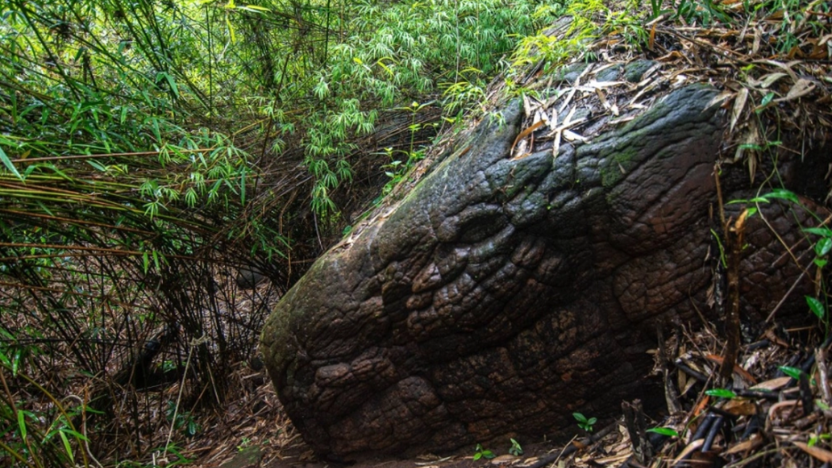
From a scientific perspective, the unique patterns and formations are the result of natural geological processes. Studies suggest that the combination of thermal expansion and contraction, caused by significant temperature variations, along with prolonged water erosion, gradually shaped the rocks into their present form. Over thousands of years, these forces created the scale-like textures that define the cave today.
Beyond its geological significance, Naka Cave holds deep cultural and spiritual meaning. In many South Asian traditions, particularly within Buddhism and Hinduism, nagas are revered as powerful, semi-divine beings often depicted as half-human and half-serpent. These mythical entities are believed to inhabit the underworld and are associated with water, protection and transformation.
Local folklore surrounding the cave is rich and varied. One of the most well-known legends tells the story of a naga named Nakkhrinthranee and a human prince, Fah Rung. Despite the prohibition against unions between nagas and humans, the two fell in love and married. When her true identity was eventually revealed, her father, angered by the forbidden relationship, destroyed the kingdom. The couple is said to have retreated into a cave to live out their lives in isolation, a cave many believe to be the present-day Naka Cave.
In broader regional mythology, nagas are also closely linked to the formation of natural landscapes. According to traditional beliefs, the Mekong River, which flows through northeastern Thailand and Laos, was created by the movement of two naga kings. These legends have led some to speculate that the serpent-like rock within Naka Cave could represent one such mythical being, resting in a state of eternal stillness.
There are also more speculative interpretations offered by visitors. Some have suggested that the formation resembles a fossilised titanoboa, an extinct species known to be the largest snake to have existed on Earth. While this theory captures the imagination, it remains unsupported by scientific evidence.
According to officials at Phu Langka National Park, the rock formations are estimated to be over 100,000 years old. The patterns observed today are the result of long-term exposure to environmental conditions, particularly the cyclical expansion and contraction caused by temperature fluctuations, combined with the gradual effects of water erosion.
Today, Naka Cave stands as both a natural marvel and a site of cultural reverence. It continues to attract visitors seeking not only to witness its unusual geological formations but also to experience the sense of mystery and spirituality that surrounds it. The site serves as a reminder of how natural landscapes can inspire stories that bridge science, history and belief, creating a legacy that endures across generations.
Source / Image Credit : Traveling , SouthEast Asian Gallery , tripzilla , Koktail Magazine