


This temple has our all!
There's no denying that this special temple which located in the bustling vicinity of Mid Valley ; Sri Maha Sakthi Mugambigai Amman Temple is a striking spiritual place, holds a story that intertwines devotion, heritage, and divine intervention.
The temple was constructed in the late 1990s, alongside the development of the renowned shopping mall. Its origins, however, trace back over a century to a simple outdoor shrine cared for by a humble family and worshipped by the local community.
Surrounded by stories that the temple somehow “protected” Mid Valley during the 1997 Asian financial crisis. But behind the legends lies a fascinating piece of history, one that began long before Mid Valley City became one of Kuala Lumpur’s most recognisable commercial landmarks.
Former Mid Valley City managing director M.K. Sen, who played a key role in the development of the mall, dismissed many of the stories surrounding the temple as urban legends. Yet, according to him, the temple’s significance to Mid Valley’s success was anything but a myth.
“Till this day, if you ask the Mid Valley owners what the reason for their success is, they will point to the construction of the temple,” Sen said in an interview.
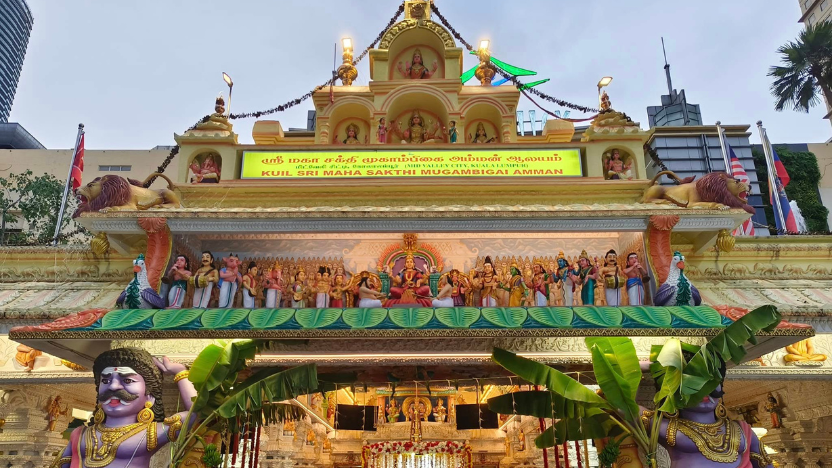
For Sen, preserving the Sri Maha Sakthi Mugambigai Amman Temple was one of the most challenging and emotionally demanding parts of the entire development, but also one of the most fulfilling. When IGB Corp Bhd acquired the land for the development of Mid Valley City in the late 1980s, the company faced several major challenges.
Among them was the need to rehouse more than 600 families living on the land, acquire around 10 privately owned homes and determine the fate of the existing Sri Maha Sakthi Mohambigai Amman Temple. The temple itself had two Bodhi trees, which were considered spiritually significant.
Sen recalled that one of the trees had previously been cut down by City Hall contractors to make way for the construction of Jalan Hishamuddin. He described what happened to those involved as a story “too sad to print”. When discussions began over the future of the remaining temple and its sacred tree, the temple’s board of trustees made an emotional plea for the temple to remain where it was.
“They made a plea for us to help them stay where they are, given the fact that this was a very spiritual tree,” Sen recalled.
According to local belief, the Bodhi tree was associated with a spiritual presence in the form of a white naga, said to manifest once a year. Sen, who was born Hindu and later converted to Buddhism, had a deep interest in spirituality. He undertook an extensive study of the temple and its various elements.
During that process, he was told that the Bodhi tree was one of the most important spiritual elements that needed to be protected.
“We knew there was something with the temple destined for us to keep. I personally felt that this temple is really a part of Mid Valley and we shouldn't allow it to be separated,” he said.
That belief led to an extraordinary decision. Rather than relocate or demolish the temple to make way for the development, Sen and his team began working with engineers and consultants to explore how the temple could remain within the new commercial complex.
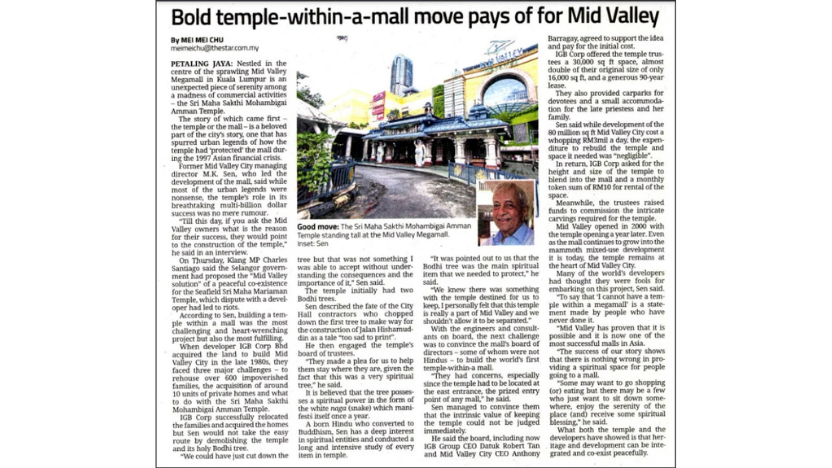
The next challenge was perhaps the biggest of all, convincing the mall’s board of directors to support the idea. Some members of the board were not Hindus, and the proposal was unprecedented. The result was a remarkable concept: preserving a place of worship within one of the country’s largest shopping complexes.
And so, Sri Maha Sakthi Mohambigai Amman Temple became more than just a temple that happened to stand beside Mid Valley.
Source / Image Credit : midvalleykali.blogspot, KUIL SRI MAHA SAKTHI MUGAMBIGAI AMMAN, MID VALLEY CITY, Temple Hunters, Methulan Panir Selvam , TheStar