


Worshipping Lord Bhairava is an act of surrender and trust. Observing His worship on Ashtami, Mondays, and Saturdays is believed to be especially sacred, as these days carry His powerful grace. Devotees turn to Lord Bhairava to seek protection, stability in work and business, relief from suffering, and freedom from negative influences that disturb peace of mind and health.
Lord Kala Bhairava, known as the Lord of Time, derives his name from "Kal" meaning time and "Bhairava," a manifestation of Lord Shiva. The ideal day for propitiating Kala Bhairava is the eighth day after the full moon, known as Ashtami after Pournami. He is revered as Kshetrapalaka, the guardian of temples, and it is a tradition in many temples to ceremonially submit the keys to the temple to Lord Kala Bhairava at closing and receive them from him at opening.
Most Shiva temples house a shrine dedicated to Kala Bhairava, whose vehicle (vahanam) is a dog.
What to do on ASHTAMI ?
Lighting the pusanikai vilakku is offered as it is symbolize the removal of darkness and obstacles from one’s life. It is believed to calm fears, bring clarity, and protect the devotee from unseen disturbances, while inviting peace, strength, and divine guidance.
How to offer the pusanikai vilakku to Lord Bhairava:
Take one fresh pusanikai. Even a small one is sufficient. Cut it into two equal halves and gently remove the seeds, shaping it neatly like a coconut split in two.
Wash the pusanikai well and apply turmeric or kumkumam as a mark of purity and reverence.
Take two small pieces of red cloth. Place black pepper in one and white pepper in the other. Wrap and tie them carefully to form wicks, similar to the wick used for Saniswaran ellu vilakku.
Place these wicks at the centre of each pusanikai half.
For the lamp, traditional oils are used as an offering. A blend of five sacred oils is preferred: gingelly oil, neem oil, coconut oil, ghee, and castor oil. If these are not available, iluppai oil may be used. Even lighting the vilakku with only gingelly oil is considered acceptable when offered with sincere faith.
Place the pusanikai vilakku before Lord Bhairava, preferably during the evening hours. As you light the lamp, offer your prayers in silence or chant Bhairava mantrams, surrendering your worries and fears at His feet.
Lord Bhairava is known as the protector of time and truth. When worshipped with devotion and humility, He is believed to remove obstacles, guard the devotee from harm, and bless life with peace, courage, and inner strength.
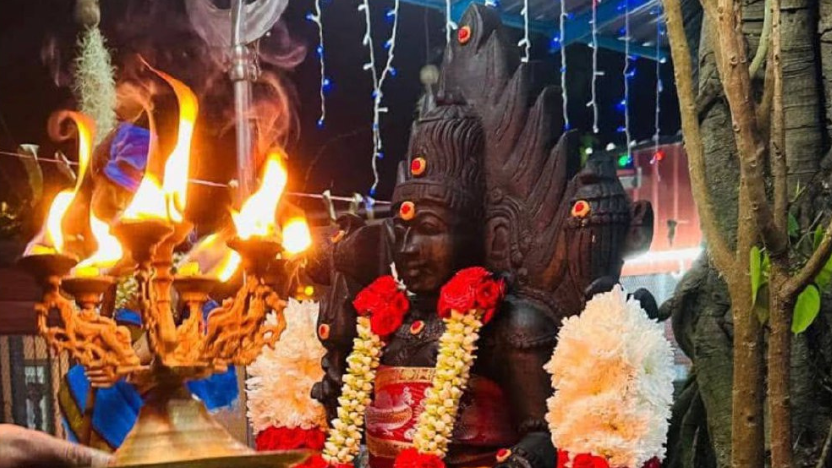
The ORIGIN of Bhairava
The origin of Bhairava can be traced to the Shiv Mahapuran, where a conversation between Lord Vishnu and Lord Brahma occurred. When Brahma arrogantly claimed to be the supreme creator, Mahadeva (Shiva) responded by creating Kala Bhairava, who severed one of Brahma's five heads to humble him and destroy his ego. Brahma, enlightened after this act, became deeply grateful to Shiva.
In his form as Kala Bhairava, Lord Shiva guards each of the Shaktipeeths, with a temple dedicated to Bhairava accompanying each Shaktipeeth temple. Kala Bhairava is depicted wearing ornaments made of twisted serpents, a tiger skin, and a ritual apron of human bones. His divine vehicle, the dog, is a symbol of loyalty and guardianship.
Kala Bhairava is also regarded as the Guru of the planetary deity Shani (Saturn), making him particularly significant for those undergoing the period of "Sade Sati" (seven and a half years of Shani’s influence). Worshipping Bhairava on Ashtami Tithi during the waning moon is considered especially powerful for them.
In Tamil, Bhairava is known as Bhairavar or Vairavar and is revered as a village guardian who protects devotees in all eight directions. In Sinhalese, he is called Bahirawa and is believed to protect treasures. Kala Bhairava, a unique manifestation of Shiva, represents time itself, a force that cannot be controlled.
Source / Image Credit : ePoojaStore.in , Pillai Center, thulaseer_reddy , Universal Divine Art, Facebook , Persatuan Kebajikan Sri Siva Sakthi Arulnyanajothu - PKSSSA