

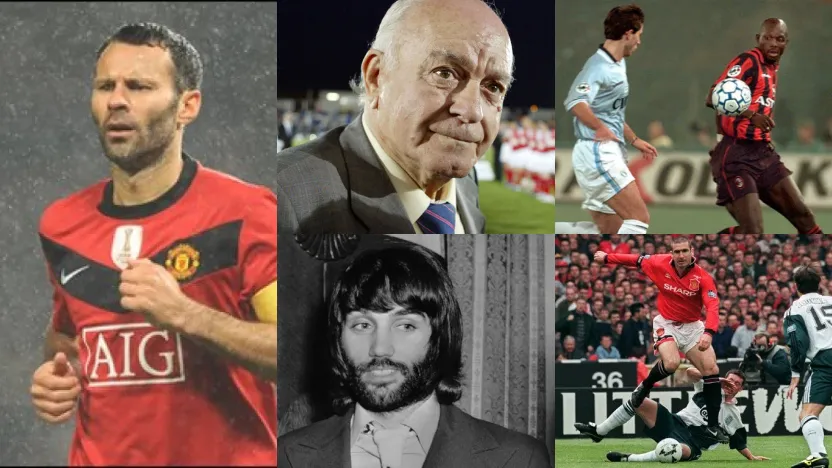
5 Football Legends Who Never Played at the FIFA World Cup
For every professional footballer, playing at the FIFA World Cup is the ultimate dream. It is the biggest stage in world football, where careers are defined and legends are made.
However, despite enjoying remarkable careers and earning legendary status, some of football's greatest names never had the opportunity to feature at the world's biggest tournament.
Whether due to injuries, their national teams failing to qualify, or unfortunate circumstances, these icons never experienced the thrill of competing at a FIFA World Cup.
Here are five football legends who never made a World Cup appearance.
Alfredo Di Stéfano (Argentina, Colombia and Spain)
Widely regarded as one of the greatest footballers of all time, Alfredo Di Stéfano enjoyed an extraordinary career with Real Madrid, winning numerous domestic and European titles.
He remains the only player to receive the prestigious Super Ballon d'Or, in addition to winning two Ballon d'Or awards.
Despite representing Argentina, Colombia and later Spain during his international career, Di Stéfano never played in a World Cup.
Argentina withdrew from qualification for the 1950 and 1954 tournaments, while Spain qualified for the 1962 World Cup only for Di Stéfano to miss the tournament through injury.
It was a cruel twist of fate that denied one of football's greatest players a place on the sport's biggest stage.
George Best (Northern Ireland)
Renowned for his dazzling skill, creativity and flair, George Best became a football icon during his time with Manchester United F.C..
Although he represented Northern Ireland throughout his international career, the nation failed to qualify for the World Cup during his prime.
Northern Ireland eventually reached the 1982 and 1986 tournaments, but by then Best was no longer part of the national team due to age and recurring injuries.
As a result, one of football's most naturally gifted players never appeared at a World Cup.
Eric Cantona (France)
Eric Cantona transformed Manchester United into a dominant force in English football and is widely regarded as one of the Premier League's greatest players.
Despite captaining France, Cantona was unable to guide Les Bleus to qualification for the 1994 FIFA World Cup. He retired unexpectedly in 1997 at just 30 years old, a year before France went on to win the 1998 World Cup on home soil. His early retirement meant he never had the chance to perform on football's grandest stage.
Ryan Giggs (Wales)
Ryan Giggs enjoyed one of the most decorated club careers in football history with Manchester United, winning numerous Premier League and UEFA Champions League titles. However, international success proved elusive. Wales narrowly missed qualification for the 1994 World Cup and failed to reach the tournament throughout Giggs' playing career.
Ironically, Wales finally qualified for the FIFA World Cup in 2022, more than a decade after Giggs had retired from international football.
George Weah (Liberia)
George Weah remains one of Africa's greatest-ever footballers and is still the only African player to have won the Ballon d'Or.
The former striker enjoyed successful spells with clubs including A.C. Milan, Paris Saint-Germain F.C. and AS Monaco FC.
Despite his individual brilliance, Liberia never qualified for the FIFA World Cup during his career, denying him the opportunity to compete on football's biggest stage.
Although these football icons never fulfilled the dream of playing at a FIFA World Cup, their achievements continue to inspire generations of players and fans.
Their careers prove that greatness is not defined solely by appearances on football's biggest stage, but by the impact they leave on the game itself. Their names remain firmly etched in football history as true legends of the sport.
Source / Image Credit : Mancunian Matters , Xyrosports , CNN Indonesia