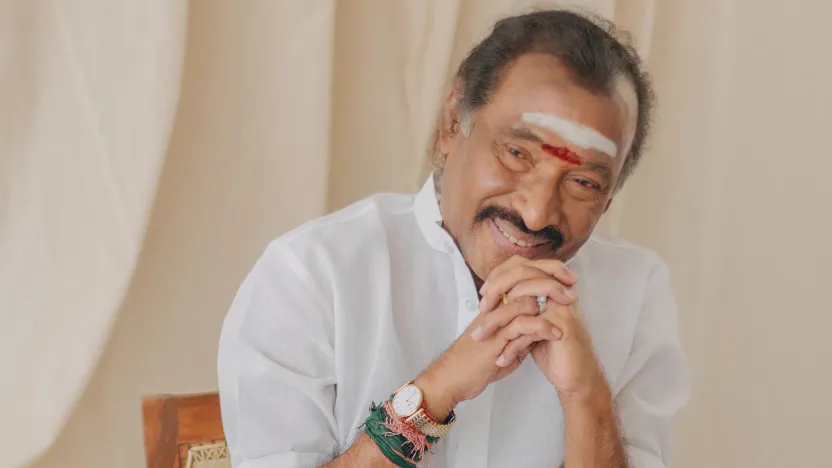
“Even if Suresh Krissna sir calls me again for a new film tomorrow, and even if it is 2 AM, I would sit down to compose.”
Just four months before his passing, legendary composer and singer Deva shared these words in an exclusive conversation with TNIE while promoting his film Charukesi, directed by Suresh Krissna. It was a simple statement, yet it said so much about the man. For Deva, music was never merely a profession. It was a passion that stayed with him through every stage of his life, one that never seemed to grow old.
The veteran composer breathed his last on October 17 at the age of 75, reportedly due to age-related issues. With his passing, Tamil cinema has lost a distinctive musical voice, but the melodies, rhythms and memories he created will continue to live on.
Born Devanesan Chokkalingam on November 20, 1950, Deva spent more than 36 years in the film industry, composing for over 400 films. His contributions earned him the Tamil Nadu State Film Award for Best Music Director and the Kalaimamani award. He entered the film industry in 1986 with Maattukara Mannaru and rose to prominence during the 1990s and early 2000s, becoming one of the most recognisable composers in Tamil cinema.
Throughout his career, Deva worked with some of the biggest stars of the industry, including Rajinikanth, Kamal Haasan, Vijayakanth, Prabhu Deva, Karthik, Sarathkumar, Vijay and Ajith. His music became part of countless cinematic memories, accompanying stories that audiences would return to for years.
From Baashha, Annamalai and Arunachalam to Pammal K. Sambandam, Avvai Shanmugi and Panchatanthiram, his filmography was filled with soundtracks that left their mark. Songs from films such as Suriyan, Gokulathil Seethai, En Aasai Machan, Eazhaiyin Sirippil, Aasai, Kadhal Kottai, Once More, Nerukku Ner, Vaalee, Minsara Kanna, Mugavaree, Kushi and Citizen further reflected the breadth of his musical journey.
Yet, even this remarkable body of work tells only part of Deva's story.
Before he became a familiar name in cinema, he had already composed more than 300 album songs. In 1985, legendary composer M. S. Viswanathan bestowed upon him the affectionate title “Thenisai Thendral” at a felicitation event. The title would remain closely associated with Deva throughout his life, capturing the musical identity he had built even before his film career took flight.
One of his greatest contributions was the way he brought gaana music into the mainstream of Tamil cinema.
Rooted in the streets and everyday lives of North Chennai's working-class communities, gaana carried a rawness, energy and honesty that made it deeply personal to the people who sang and listened to it. Deva helped bring that sound to a much wider audience, allowing it to find a place in popular cinema without losing the spirit that made it special.
Songs such as “Kathadikkuthu Kathadikkuthu”, “Udhayam Theatre La”, “Vaadi Potta Pulla Veliya” and “Thirupathi Elumalai” became part of his enduring musical legacy. His influence can still be felt in contemporary Tamil film music and the independent Tamil music scene, where gaana continues to find new listeners and new voices.
For many, Deva will always be remembered as the man who helped make gaana an inseparable part of Tamil cinema. But to remember him only through that genre would be to overlook another side of his talent.
For all the energy of his gaana compositions, Deva also had a soft corner for melodies. Songs such as “Mudhan Mudhalil Parthen”, “Kaathala Kaathala”, “Mottu Ondru” and “Oodha Oodha” revealed his gentler musical sensibilities, reminding listeners that his creativity could move comfortably between very different emotions.
He could make audiences celebrate, laugh, fall in love and feel the weight of a moment through music. His work was never confined to one mood or one sound.
Then there was his background music, particularly the iconic theme associated with Annamalai. Inspired by the James Bond theme music, it became one of the most recognisable musical signatures associated with Rajinikanth. Over time, it grew beyond the film itself, becoming a familiar part of the anticipation surrounding the Superstar's cinematic appearances. Its use in Jailer 2 continues that enduring connection between Deva's music and Rajinikanth's screen persona.
Deva's career was not without controversy. As the internet grew, discussions about similarities between some of his compositions and international tracks became increasingly prominent. Yet, what stood out to many was that Deva did not simply shut down those conversations or respond with hostility. He addressed questions about musical references, while other composers and creators also spoke about the pressures and realities of working within the film industry.
Whatever the debates surrounding his work, his contribution to Tamil cinema and the affection he inspired among fellow musicians remained significant.
Perhaps that affection was most visible in the way younger generations of composers continued to seek him out. A. R. Rahman, Anirudh Ravichander, G. V. Prakash Kumar, Sean Roldan, Santhosh Narayanan and Sam C. S. were among the composers who worked with Deva and invited him to lend his voice to their music.
There was something meaningful about that connection. A composer who had helped shape the sound of an earlier generation continued to be welcomed by musicians who were creating the sounds of a new one. His voice became a bridge between musical generations, carrying with it the familiarity of an era while finding a place in new compositions.
Even towards the final chapter of his career, Deva continued to embrace new challenges with the enthusiasm of someone who had only just begun.
His final film as a composer, Charukesi, was particularly close to his heart because it offered him the opportunity to create a soundtrack rooted in Carnatic music, something he had long wanted to explore. His willingness to take on a project he had dreamed of completing spoke volumes about his relationship with his craft. Despite everything he had already achieved, there was still more he wanted to learn, create and experience.
The same passion carried him onto concert stages. Inspired by the growing popularity of live musical performances, Deva embarked on a concert tour that took him from Chennai to Coimbatore, Johor Bahru and London. For an artist whose songs had accompanied generations of listeners, seeing younger audiences respond to his music brought him a special kind of happiness.
After a recent concert tour, he visited Rajinikanth and shared his delight at seeing young people enjoy his songs. He reportedly expressed the hope that he could continue living with that happiness for another 10 to 15 years.
It was a wish that revealed how much music still meant to him. Even after decades in the industry, after hundreds of films and countless songs, the joy of seeing people connect with his work remained something he cherished.
Perhaps that is the most moving part of Deva's story. Beyond the title of Thenisai Thendral, beyond his reputation as a pioneer of gaana and a composer of memorable melodies, he remained a man who simply loved music. His desire to keep composing, performing and discovering new possibilities never seemed to fade.
In one of his reflections on his craft, Deva offered a piece of advice that beautifully captures the philosophy behind his journey.
“Every job has its own complexities and requires hard work, but the secret ingredient to doing a good job is love. Whatever you do, do it with love. Ishta pattu kashta padanum.”
The Tamil phrase carries a simple but powerful message: love what you do and be willing to work hard for it.
Deva lived by that belief. He continued to create long after he had established his place in the industry, embraced opportunities that excited him, and found joy in hearing his music reach new generations.
His life reminds us that a true passion does not necessarily diminish with age or achievement. Sometimes, it grows deeper, becoming an inseparable part of who we are.
Deva may have taken his final bow, but his music will continue to play in theatres, at concerts, in celebrations and in the memories of those who grew up with his songs. And every time those familiar tunes begin, a part of Thenisai Thendral will return, reminding us of a man who never stopped loving what he did.
Source : newindianexpress
You may be interested in

Bollywood Style 1 Pair Of Earrings + 1 Necklace Vintage Jewelry Set Retro Design Inlaid Gemstone Match Daily Outfits Party Accessories

Ready stock lotus design indian saree

Royal Heritage Embroidered Anarkali Gown for Women | Premium Festive Wear by RANGOLI BAZAAR

Indian Wedding Forehead Netti Pattam & Hand Wrist Pattam Gold Plated Traditional Bridal Ceremony Set