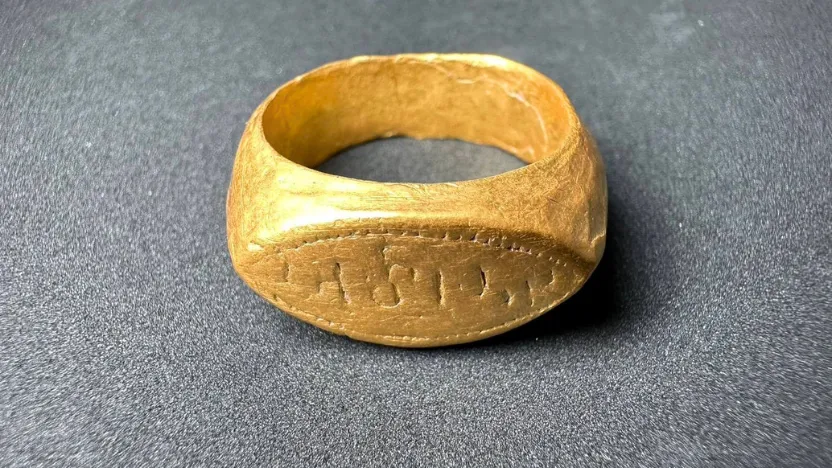
A remarkable archaeological discovery in western Thailand is offering new insights into the region's ancient past after researchers uncovered two rare gold rings believed to be around 2,000 years old. One of the rings bears an inscription in the ancient Indian Brahmi script, highlighting the deep cultural and trade connections that once existed between India and Southeast Asia.
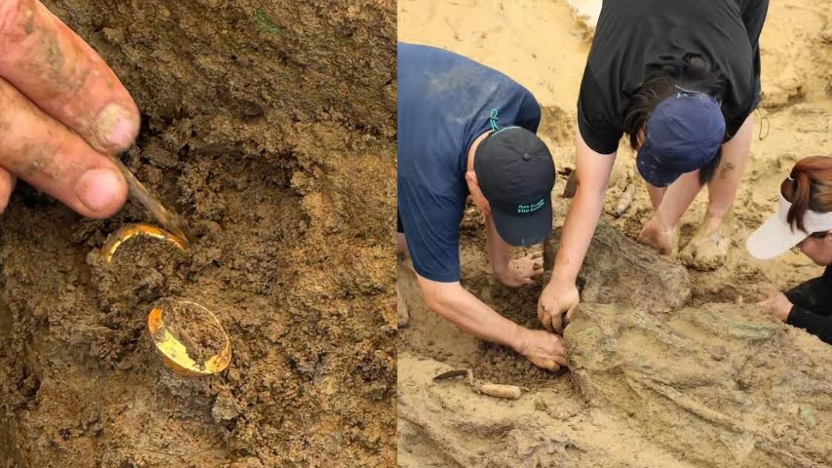
The discovery was made at the Don Yai Thong archaeological site in Thailand's Phetchaburi province, about 130 kilometres southwest of Bangkok. Excavations began earlier this year after local villagers stumbled upon fragments of ancient bronze drums in nearby rice fields.
Since the excavation started, archaeologists have unearthed an impressive collection of Iron Age artefacts, including gold ornaments, glass beads, pottery and human remains dating back approximately 2,500 to 1,500 years.
Among the latest discoveries are two exceptionally well-preserved gold rings found alongside the remains of a child believed to be under the age of 12. One ring is plain, while the other features an inscription in Brahmi, one of the oldest writing systems of ancient India and the foundation for several scripts used across South and Southeast Asia.
Researchers translated the inscription as "Pusarakhitasa," meaning "the one protected by Pushya." Pushya is regarded as one of the most auspicious constellations in Indian astrology, making the inscription a significant cultural and religious find.
The rings were discovered within a burial site that has already yielded nine human skeletons. Archaeologists noted that each individual was buried in a similar ritualistic manner, facing northeast with bronze objects placed above their heads, a burial custom rarely documented in Thailand.
In addition to the rings, the excavation uncovered bronze artefacts, pottery, colourful glass beads and the well-preserved jawbone of what is believed to be a cow or buffalo. These findings suggest the possibility of ritual animal offerings, although researchers say further studies are needed to confirm this theory.
Experts believe the luxurious burial goods indicate that some of those buried were members of the social elite. Based on the Brahmi inscription, researchers also suggest that the rings may have belonged to members of the Vaishya community, traditionally associated with merchants, traders, artisans and farmers in ancient Indian society.
The discovery provides fresh evidence of long-distance trade, cultural exchange and religious influence between ancient India and Southeast Asia during the Iron Age. It also raises new questions about how social status influenced burial practices in the region more than two millennia ago.
Excavation work has temporarily paused due to Thailand's rainy season and the risk of flooding. Archaeologists plan to resume research once conditions improve, with further studies including 3D mapping of the burial site and scientific dating of charcoal samples to better understand the site's history.
Before undergoing conservation, the newly discovered artefacts will be displayed to the public, with hopes that they will eventually become part of a permanent museum exhibition, allowing visitors to witness one of Thailand's most fascinating archaeological discoveries in recent years.
Source : NDTV , The Indian Express
You may be interested in

Ready stock lotus design indian saree

Indian Wedding Forehead Netti Pattam & Hand Wrist Pattam Gold Plated Traditional Bridal Ceremony Set
Bollywood Style 1 Pair Of Earrings + 1 Necklace Vintage Jewelry Set Retro Design Inlaid Gemstone Match Daily Outfits Party Accessories
Royal Heritage Embroidered Anarkali Gown for Women | Premium Festive Wear by RANGOLI BAZAAR