


Adimudi Siddhar, originally known as Ramasamy, was born in 1835 in a village near Chennai in Tamil Nadu. During the early part of his life, he lived as a householder with his wife and children. For nearly four decades, he led a simple family life before undergoing a profound spiritual transformation that would later define his legacy.
According to traditional accounts, in 1875 he arrived in Tiruvannamalai by the divine grace of Lord Annamalaiyar, the presiding deity of the sacred Arunachaleswarar Temple. Tiruvannamalai, long regarded as one of the most important spiritual centres in South India, became the place where Ramasamy dedicated himself entirely to spiritual practice and service.
During his time in Tiruvannamalai, he became closely associated with the Gowthama Ashram. The ashram is traditionally linked to the revered sage Gowthama Munivar, who, according to Hindu belief, was responsible for the formation of the Godavari River in present-day Maharashtra after receiving instructions from Lord Shiva (Paramashiva). Adimudi Siddhar was fortunate to perform daily puja at this ashram and contributed significantly to maintaining the sacred space.
He soon became known for his unique appearance and disciplined ascetic life. Adimudi Siddhar was described as having 108 long dreadlocks, a symbolic feature often associated with Lord Shiva himself. Despite the presence of devotees and visitors, he maintained a strict personal vow of austerity. He refused to accept food offered by others and sustained himself only on fruits and roots that he gathered from the surrounding forests.
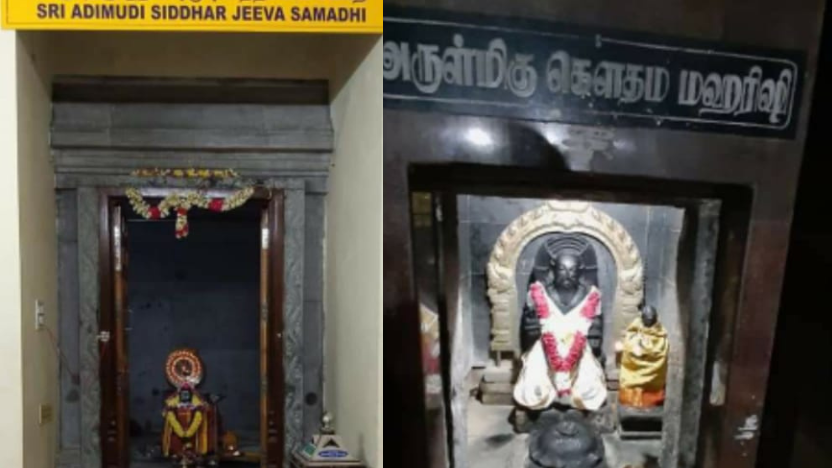
Over time, his spiritual devotion and disciplined lifestyle earned him the name “Adimudi Siddhar.” Though born as Ramasamy, he came to be revered as a Siddhar, a realised spiritual master believed to possess deep wisdom and mystical powers. Devotees also attribute several miracles to him during his years in Tiruvannamalai.
One of his most significant contributions was the formation of the sacred path around the Arunachala hill, which later became widely known as the Girivalam path. This path is now an important pilgrimage route for devotees who walk around the Arunachala hill as an act of devotion to Lord Shiva.
Adimudi Siddhar continued his spiritual life in Tiruvannamalai until the early twentieth century. In 1904, on the sacred day of Chitra Pournami, he is said to have announced that he would soon leave his physical body. On that day, he consciously entered Jeeva Samadhi, a state in which realised saints are believed to leave their physical form while remaining spiritually present.
His Jeeva Samadhi is located at the Gowthamar Ashram in Athiyandal, near Tiruvannamalai in Tamil Nadu. Even today, devotees visit the site to pay their respects and remember the life and spiritual contributions of Adimudi Siddhar, who played a significant role in the sacred traditions surrounding the Arunachala hill.
Source / Image Credit : Justdial , chinnuadhithya , agathiyarpogalur.blogspot