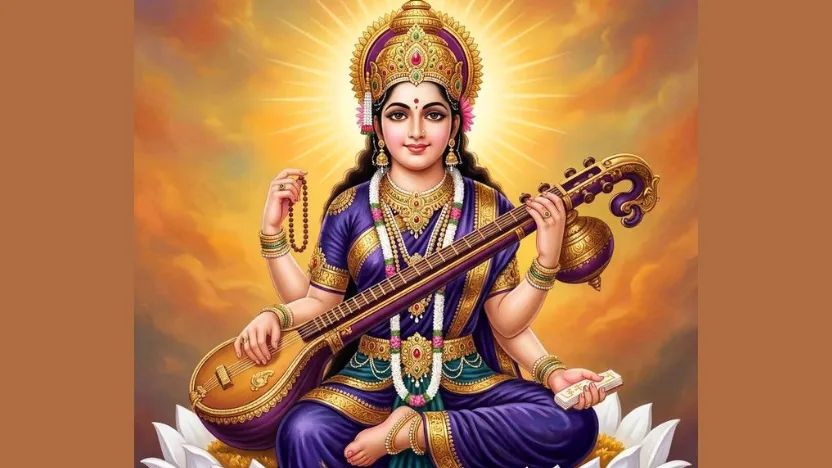
Navarathiri is a time to honour the divine feminine and reflect on the different forms of strength, compassion and wisdom represented by the goddesses. Among them is Goddess Saraswati, who holds a special place in Hindu tradition as the Goddess of Knowledge, Learning, Music and Wisdom.
For students preparing for examinations, musicians pursuing their passion, teachers sharing their knowledge and anyone seeking clarity in life, Goddess Saraswati represents the importance of learning and the pursuit of wisdom. But beyond being worshipped for academic success, her story and divine symbols carry deeper meanings that continue to inspire devotees.
Goddess Saraswati is traditionally associated with Lord Brahma, the creator of the universe. According to Hindu mythology, Brahma initially found his creation lacking direction and meaning. Goddess Saraswati, the embodiment of wisdom and knowledge, emerged to bring order and guide the process of creation.
Her presence is associated with the development of the cosmos, including the sun, moon and stars, in popular retellings of the legend. Saraswati is also known as Vagdevi, a name associated with speech and expression. Her significance extends beyond knowledge alone, representing the ability to communicate clearly, express ideas and use words meaningfully.
Some Puranic legends also explain why Lord Brahma is worshipped in relatively few temples. One version tells of Saraswati cursing Brahma after becoming upset with him, while another recounts her anger when he married Gayatri to complete a yajna in her absence. These are traditional mythological accounts, with different versions found across Hindu storytelling.
The name Saraswati is also associated with a river mentioned in the Rig Veda, reflecting the connection between flowing water, speech, inspiration and the flow of knowledge.
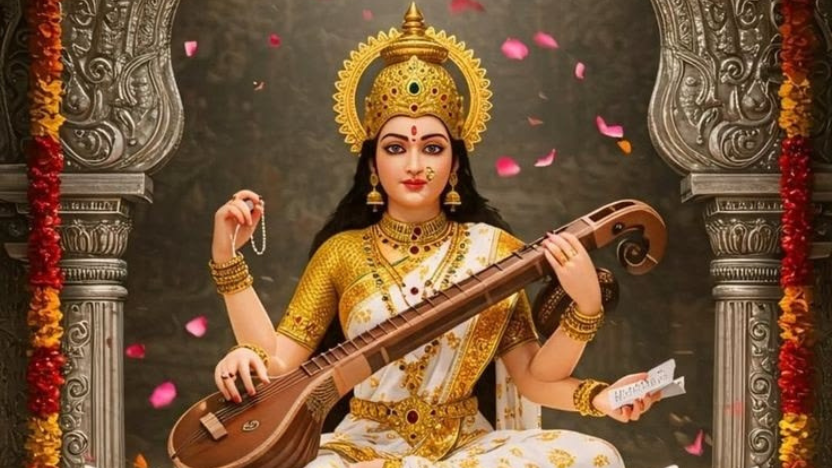
Goddess Saraswati is commonly depicted wearing a white sari and seated on a lotus, often holding a veena, a book, a crystal mala and a pot of water. Each symbol carries a message about the pursuit of knowledge and a balanced life.
1. The veenai - the beauty of music and creativity
The veena represents music, harmony and the creative arts. It reminds devotees that knowledge is not limited to books and academic learning; it also finds expression through music, creativity and artistic talent.
2. The book - the pursuit of knowledge
The book is associated with the Vedas and the wisdom contained in sacred teachings. It represents the importance of learning, understanding and continually seeking knowledge.
3. The mala - concentration and meditation
The crystal mala symbolises focus, contemplation and the discipline needed to gain deeper understanding. It reminds devotees that wisdom requires patience and a calm, attentive mind.
4. The pot of water - purity and renewal
The pot of water represents sacredness and purification. Water is essential for life, and its symbolism reflects the potential to cleanse, renew and nourish.
5. The lotus - purity and perseverance
The lotus represents purity and endurance. Growing in muddy water yet blooming beautifully, it is often understood that wisdom and goodness can flourish even when life presents challenges.
Her four hands are also interpreted as representing different aspects of the human personality, including the mind, intellect, alertness and ego.
Have you ever heard the saying that we should be careful about what we say because our words have power?
Popular mythology holds that Goddess Saraswati resides on the tongue at a particular time each day, making spoken words come true. This is a traditional belief rather than a proven fact, but its message remains meaningful: words can influence relationships, inspire others and shape the way we experience the world.
As the goddess associated with speech and wisdom, Saraswati reminds devotees to communicate thoughtfully, speak with clarity and use their words responsibly.
The worship of Goddess Saraswati is especially meaningful to students, teachers, musicians, writers and artists. Devotees seek her blessings for knowledge, concentration, creativity and the ability to express themselves well.
In Hindu tradition, Basant Panchami is widely associated with the worship of Saraswati and the arrival of spring. In some communities, children are introduced to writing on this auspicious occasion as a way of celebrating learning and seeking the goddess's blessings.
During Navarathiri, Saraswati Poojai is also observed in many traditions, with books, musical instruments and tools of learning placed for worship. The practice reflects the belief that knowledge and the skills we use in everyday life deserve respect and gratitude.
Devotees may also recite the Saraswati Chalisa, a devotional prayer of 40 verses seeking blessings for wisdom, speech and learning.
Image Credit : Pinterest
Source : servdharm.
You may be interested in

Indian Wedding Forehead Netti Pattam & Hand Wrist Pattam Gold Plated Traditional Bridal Ceremony Set

Ready stock lotus design indian saree

Royal Heritage Embroidered Anarkali Gown for Women | Premium Festive Wear by RANGOLI BAZAAR

Bollywood Style 1 Pair Of Earrings + 1 Necklace Vintage Jewelry Set Retro Design Inlaid Gemstone Match Daily Outfits Party Accessories