

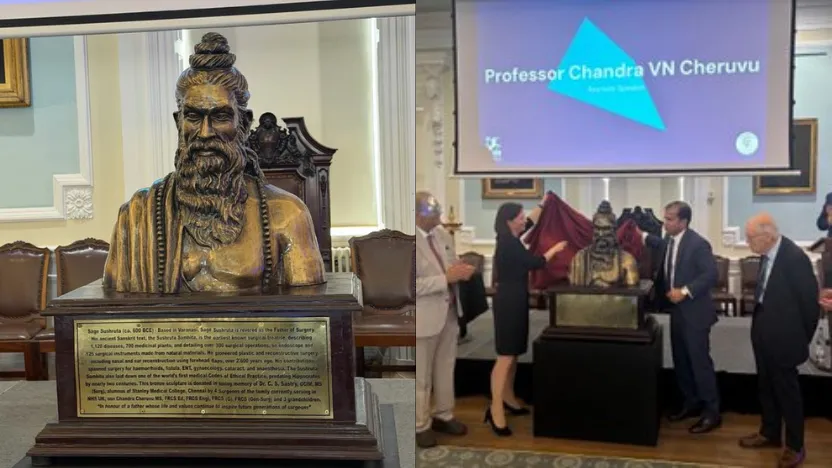
More than 2,600 years after he transformed into the field of medicine, Acharya Sushruta continues to earn global recognition. The Royal College of Surgeons of Edinburgh has unveiled a 90-kilogram bronze statue in honour of the ancient Indian physician, celebrating his extraordinary contributions to surgery and medical science.
Widely regarded as the "Father of Surgery" and the pioneer of plastic surgery, Sushruta's work laid the foundation for many surgical principles that continue to influence modern medicine today.
The Royal College of Surgeons of Edinburgh, recognised as the world's oldest surgical college, unveiled the statue to acknowledge Sushruta's remarkable achievements in advancing surgical knowledge centuries before many renowned Western physicians.
Believed to have lived around 600 BCE, Sushruta was born in Kanyakubja, present-day Kannauj in Uttar Pradesh, before moving to Kashi (now Varanasi), which was then one of the most important centres of medical learning in ancient India. It was there that he practised medicine, trained students and authored one of history's most influential medical texts.
Sushruta's greatest contribution is the Sushruta Samhita, an extensive medical treatise that remains one of the most comprehensive medical compilations from the ancient world.
The text documents:
- 1,120 diseases and medical conditions
- More than 700 medicinal plants
- Around 300 medical procedures
- Nearly 120 surgical instruments
Consul General unveiled the bronze sculpture of Sage Sushruta, revered as the Father of Surgery, at the Royal College of Surgeons of Edinburgh @RCSEd .
The ceremony celebrated India’s ancient medical heritage, the historical India-Scotland links in medicine and surgery, and the… pic.twitter.com/xM59OcKCeM— India In Scotland (@IndiaInScotland) June 19, 2026
Beyond surgery, the Samhita explores medicine, paediatrics, toxicology, psychiatry, ophthalmology, ear, nose and throat disorders, and geriatric care, highlighting the remarkable breadth of medical knowledge available in ancient India.
What makes Sushruta's work particularly extraordinary is how advanced many of his observations were.
He classified surgery into eight distinct categories, including incision, excision, puncturing, extraction, drainage and suturing. His writings also outlined structured surgical training, emphasising practical learning and hands-on experience, principles that remain central to medical education today.
Sushruta also documented conditions resembling diabetes, obesity and cardiovascular diseases, recognising the importance of lifestyle and physical activity in preventing and managing illness.
His detailed descriptions of burns, frostbite, heatstroke and traumatic injuries demonstrate an understanding of emergency medicine that historians believe was far ahead of its time.
The Edinburgh tribute is not the first international recognition of Sushruta's legacy. The Royal Australasian College of Surgeons in Melbourne previously installed a marble statue of the legendary physician, donated by renowned cardiothoracic surgeon Dr K.M. Cherian.
Although separated by continents, both institutions share the belief that the history of surgery cannot be fully told without acknowledging Sushruta's groundbreaking contributions.
Medical scholars have also praised his work over the decades. In The Source Book of Plastic Surgery, surgeon Frank McDowell described Sushruta as a physician who combined careful observation with logical scientific reasoning, making him one of history's greatest surgical minds.
The unveiling of Sushruta's statue in Scotland is more than a tribute to an individual. It is a recognition that groundbreaking scientific innovation has existed across civilisations for thousands of years.
Source / Image Credit : Moneycontrol ,