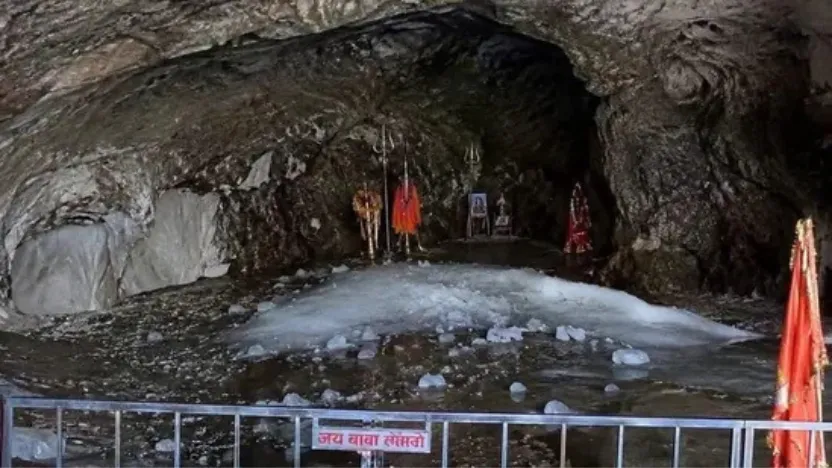
The early shrinking of the sacred ice Shivlingam at the Amarnath Cave has sparked concern among devotees, environmentalists and religious organisations, with many questioning whether climate change is altering one of Hinduism's holiest pilgrimage sites.
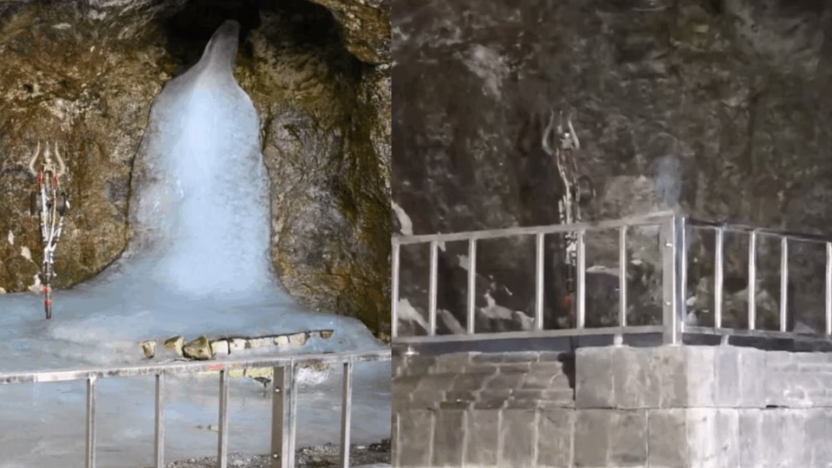
Just days after this year's Amarnath Yatra began, visitors to the cave noticed that the naturally formed ice Shivlingam had already reduced significantly in size. Images and videos shared on social media quickly went viral, prompting discussions about the possible reasons behind the unusually early melting.
Among those who voiced concern was People's Democratic Party (PDP) leader Iltija Mufti, who said the rapid melting should serve as a wake-up call on the impact of environmental degradation.
She pointed to climate change, large-scale tree felling, illegal mining, poor waste management and the depletion of water resources as contributing factors affecting the fragile Himalayan ecosystem.
The Shri Amarnath Barfani Langars Organisation (SABLO) has also expressed concern, calling for a comprehensive scientific investigation into the changing condition of the naturally formed ice Shivalingam.
Has the ice Shivlingam really melted?
Several devotees who recently completed the pilgrimage confirmed that the ice formation appeared much smaller than expected. One pilgrim from Madhya Pradesh said the shrinking was clearly visible during his visit.
"In previous years, devotees could witness the Shivling for more than a month. Now, within just a few days of the Yatra, it has already reduced considerably in size," he shared.
Similar instances of early melting have reportedly occurred in previous years, including 2004, 2006, 2007, 2016 and 2020. However, scientists note that there is currently no detailed scientific study measuring exactly how much the formation has melted this year.
Experts say rising temperatures in the Himalayas are likely one of the biggest contributing factors.
The Himalayan region is warming faster than many other mountain ecosystems around the world. Changes in snowfall patterns, retreating glaciers and rising average temperatures have already been documented across Jammu and Kashmir.
Located nearly 3,900 metres above sea level, the Amarnath Cave is highly sensitive to even small changes in temperature and humidity. Since the sacred Shivling forms naturally through freezing water droplets inside the cave, warmer conditions can cause it to shrink much earlier than usual.
While climate change is considered a major factor, experts believe it may not be the only reason. Over the years, the Amarnath pilgrimage has seen significant infrastructure development to accommodate the growing number of devotees. Roads have been widened, temporary accommodation expanded and community kitchens, known as langars, have moved closer to the shrine.
The introduction of electricity, solar lighting and other facilities has also changed the surrounding environment. More recently, the government approved a ropeway project, while discussions are ongoing about constructing a tunnel connecting Sheshnag and Panchtarni.
Some experts believe these developments may also be influencing the cave's delicate microclimate, although more scientific research is needed before any conclusions can be drawn.
SABLO has urged authorities to establish an independent panel comprising experts in glaciology, geology, climate science, environmental science, cave climatology and structural engineering.
The organisation believes a multidisciplinary study is necessary to understand the factors affecting the formation and preservation of the sacred ice Shivlingam. For millions of devotees, the Amarnath Shivlingam is far more than a natural ice formation.
As thousands continue the annual pilgrimage, many hope that future conservation efforts will strike a careful balance between improving facilities for pilgrims and protecting the fragile Himalayan environment that has sustained this centuries-old spiritual tradition.
Source / Image Credit : Hindustantimes , Bitter Winter , News18
You may be interested in

Ready stock lotus design indian saree

Indian Wedding Forehead Netti Pattam & Hand Wrist Pattam Gold Plated Traditional Bridal Ceremony Set
Royal Heritage Embroidered Anarkali Gown for Women | Premium Festive Wear by RANGOLI BAZAAR

Bollywood Style 1 Pair Of Earrings + 1 Necklace Vintage Jewelry Set Retro Design Inlaid Gemstone Match Daily Outfits Party Accessories