

Some love stories are remembered through poems. Others are remembered through photographs and memories.
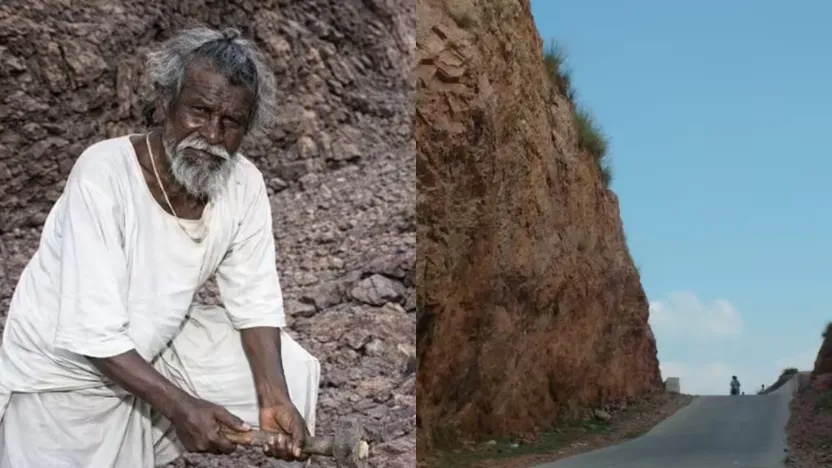
But one man in India turned his love into a road that still changes lives today. His name was Dashrath Manjhi, a poor daily wage labourer from the small village of Gehlaur in Bihar. He had no wealth, no education, no machinery and no government support.
All he had was a hammer, a chisel and a promise born from heartbreak. Located among rocky hills in Bihar, Gehlaur was a village cut off from the outside world by a massive mountain. There were no proper roads connecting the villagers to nearby towns.
To reach a hospital, school or marketplace, families had to travel a dangerous route of nearly 70 kilometres around the mountain. For generations, people accepted this hardship as part of life. Until tragedy struck one ordinary family.
In 1959, Dashrath Manjhi's wife, Falguni Devi, was seriously injured while crossing the rocky hillside to bring him food as he worked. She needed urgent medical treatment, but there was no direct road to the nearest hospital. By the time help could reach her, it was too late and she died before receiving the treatment that might have saved her.
For many, grief would have ended the story. For Dashrath Manjhi, it became the beginning.
Standing before the mountain that had taken away the love of his life, he made a decision that seemed impossible. If the mountain had stolen his wife, he would cut through the mountain.
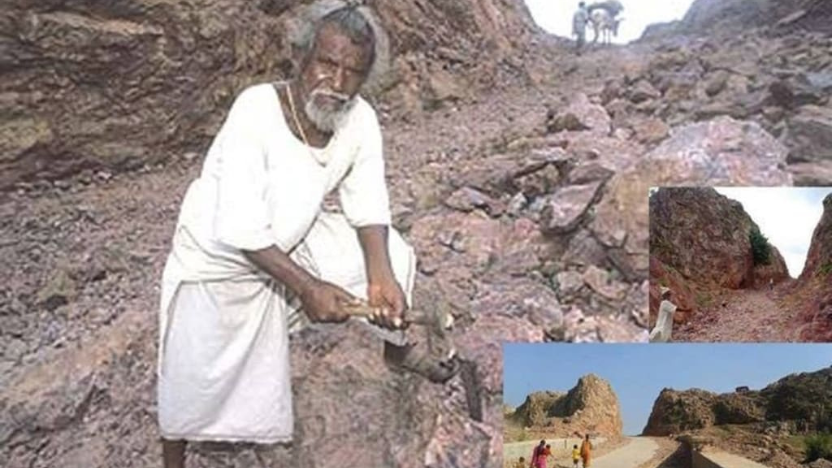
Around 1960, armed with nothing more than a hammer and a chisel, Dashrath Manjhi began breaking the mountain apart. There were no bulldozers. No engineers, no sponsors, no one believed he could succeed. Many laughed at him.
Some called him mad. Others mocked him for wasting his life chasing an impossible dream. But every insult only strengthened his resolve.
During the day, he worked as a labourer to earn just enough money to survive. Whatever little he earned, he saved to buy tools.
When money ran short, he sold his goats, one of the few possessions he owned—to continue his work. Then, every morning and every evening, he returned to the mountain.
One strike. One stone. One step closer. A mountain slowly gave way. Progress was painfully slow. Each swing of the hammer broke away only tiny pieces of rock. Days became months. Months became years. Years became decades. Yet Dashrath Manjhi never stopped.
After 22 years of relentless determination from 1960 to 1982, he achieved what many believed could never be done.
Using only hand tools, he carved a passage approximately 110 metres long, around 9 metres wide and up to 8 metres deep through solid rock. The road dramatically reduced the distance between villages and nearby towns. What had once required a journey of up to 70 kilometres could now be travelled in just a fraction of the distance.
The road transformed countless lives. Pregnant mothers reached hospitals in time. Children gained easier access to schools, farmers travelled more easily to markets, families no longer had to risk dangerous journeys around the mountain.
What began as one husband's grief became a lifeline for an entire community. His love saved people he would never know. For many years, Dashrath Manjhi remained unknown outside his village. He never carved the road for fame. He never asked for money.
He simply believed no one else should lose someone they loved because a road did not exist. Eventually, journalists and government officials discovered his extraordinary achievement.
India came to know him as the "Mountain Man." The Bihar government honoured his remarkable contribution, and his story inspired millions across the country.
Dashrath Manjhi passed away on 17 August 2007 at the age of 73 while undergoing treatment for gall bladder cancer at AIIMS Delhi.
He was given a state funeral an extraordinary honour for a man who had once been dismissed as a dreamer. Today, the road he carved still stands in Gehlaur. It is more than a road through a mountain. It is proof that love is not always expressed through words.
Sometimes, love is measured in sacrifice. Sometimes, it is measured in 22 years of unwavering determination.
And sometimes, one ordinary man reminds the world that even the tallest mountain can be moved, not by power or wealth, but by purpose, perseverance and a heart that refused to give up. Dashrath Manjhi did not build a monument for the woman he loved. He built a future for generations he would never meet.
Perhaps that is what makes his story one of the greatest love stories ever lived.
Source / Image Credit : India , The Times of India , Vocal Media