

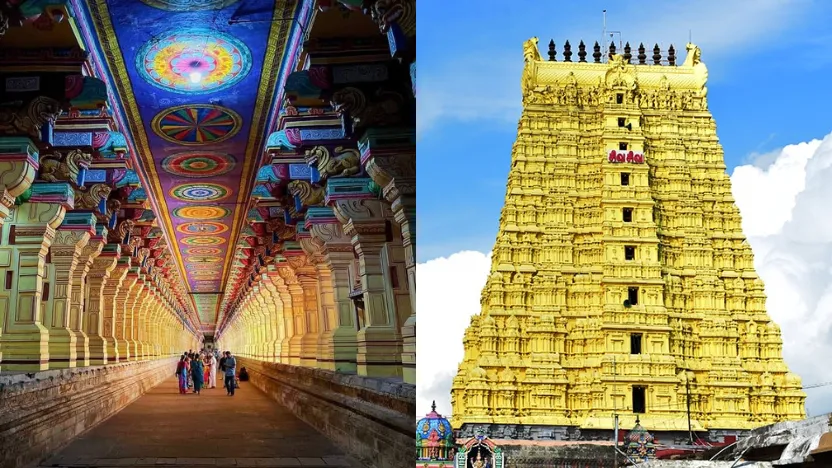
Deep in the sacred town of Ramanathaswamy Temple, there exists an architectural wonder that continues to leave visitors awestruck not just for its beauty, but for the mystery behind its creation.
At first glance, the temple’s corridors appear grand and majestic. But as you begin to walk through them, the true scale slowly unfolds. Stretching nearly 4,000 feet, this is recognised as the longest temple corridor in the world, lined with 1,212 towering pillars, each rising about 30 feet high. Every pillar is intricately carved, no two exactly alike, yet together they create a perfect visual rhythm that feels almost unreal.
What makes this even more fascinating is not just its size, but its precision. If you stand at one end of the corridor and look straight ahead, the endless rows of pillars appear to converge into a single point. This optical alignment, achieved centuries ago, continues to puzzle architects even today.
Built over 800 years ago, long before modern engineering tools or technology existed, the corridor stands as a testament to ancient brilliance. Crafted from massive blocks of granite, each weighing several tons, the structure has withstood time, weather, and shifting coastal soil without losing its alignment or stability.
Historians believe that the stones were transported from quarries located miles away, moved using simple tools, manpower, and sheer determination. Beneath the ground lies a complex foundation system, carefully designed to distribute weight evenly across the sandy terrain, a technique so advanced that it continues to be studied by modern engineers.
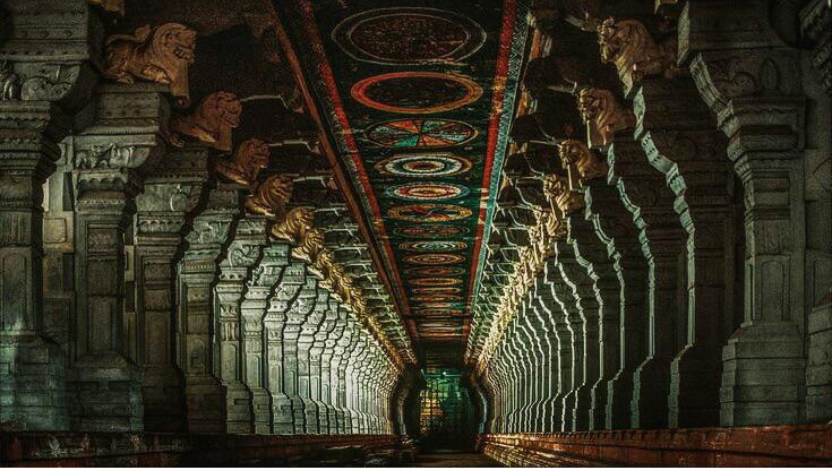
Yet, the mystery deepens when one considers how this massive project was completed. Built across different periods by different rulers and craftsmen, the corridor maintains a remarkable consistency in design, proportion, and craftsmanship. It suggests the existence of a highly organised system of knowledge, passed down across generations with extraordinary precision.
Beyond its architectural marvel lies its deep spiritual significance. The temple is home to 22 sacred teerthams within its premises, holy water sources believed to cleanse the soul and guide one closer to liberation. Devotees walk through the corridors, receiving drops of water from each teertham, turning the journey itself into a sacred ritual.
The corridors are not just pathways of stone, but pathways of experience, where devotion, geometry, and mystery meet.
Even today, as scholars attempt to decode the secrets behind its construction, many questions remain unanswered. How did ancient builders achieve such flawless alignment? What knowledge allowed them to create such scale without modern tools? And how did this vision remain unchanged across centuries?
Perhaps, the answer lies not just in science or history, but in the spirit of the time, where devotion and craftsmanship came together to create something truly timeless.
Rameswaram’s corridor is not just an architectural wonder. It is a silent reminder that the past still holds mysteries we are yet to fully understand.
Source / Image Credit : hinduvigyan , pilgrimagetour
 : Muthu Kumaran ( SSMK Photography ) , jüSTa Hotels & Resorts