


Thirupparankundram is revered as the first among Lord Murugan’s sacred abodes, a divine hill where history, faith, and ancient craftsmanship come together in remarkable harmony. Known as திருப்பரங்குன்றம், this sacred site is one of the rare places where Shaiva, Vaishnava, and Murugan traditions coexist within a single rock-cut complex.
Carved entirely out of a massive hill in Madurai, the Thirupparankundram Rock-cut Cave Temple stands as one of Tamil Nadu’s oldest and most significant cave shrines. Its origins trace back to the Pandyan dynasty, likely around the 8th century, when kings devoted to art and spirituality commissioned monuments that blended simplicity with astonishing detail. The cave’s architecture, sculpted from a single rock reflects the skill of ancient artisans, echoing styles seen in Mahabalipuram and Ellora.
Within the rock-cut façade, one finds Shaiva bas-reliefs that include Bhairava with his sacred dog, Vighneswara (Ganesha), and revered Shaiva saints such as Appar, Sambandar, and Siruthondar. Though time has damaged many carvings, their presence helps date the temple and affirm its deep roots in the Shaiva tradition. A partially defaced figure believed to be Vedavyasa stands as another reminder of the spiritual scholarship that shaped India’s religious landscape.
The temple rests at the foot of the towering Skandamalai : the hill of Skanda, or Murugan, rising 1,048 feet above the plains with a circumference of over two miles. This hill has long been sacred to Hindus. It hosts some of the region’s earliest Shaiva cave temples and is closely linked to the evolution of the grand Thirupparankundram Murugan Temple complex, expanded across centuries from the 7th to the 15th.
The spiritual significance of this hill extends beyond Hindu traditions. On its western slopes lie some of the oldest Jain beds, inscribed in Tamil-Brahmi script from as early as the 2nd century BCE. More Jain inscriptions, carvings, and stone beds appear along the trail that climbs toward the rock-cut Kasi Viswanathar temple. These monuments, dating between the 7th and 11th centuries, reflect the coexistence of diverse faiths that once flourished here.
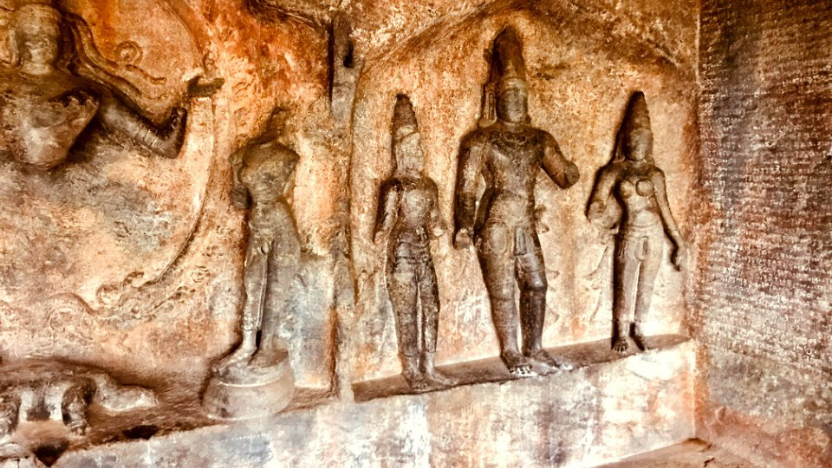
Near the southern face of the hill are the sacred Saraswati Tirtha, a small Saptamatrika temple, and the Thirupparankundram Rock-cut Cave and Inscription monument, dated between the 8th and 13th centuries. Both this cave temple and the nearby Jain beds, often mistakenly called the Pancha Pandava beds are protected national monuments under the Archaeological Survey of India.
Source : Wikipedia, the free encyclopedia , Wikiwand, Creazilla