


Have you ever heard of a Ganpati with three trunks sitting on a peacock?
The Trishund Mayureshwar Ganpati Temple in Somwar Peth, Pune, is a must-visit for anyone who loves history and stunning architecture. This revered Peshwa-era shrine is home to one of the rarest forms of Lord Ganesha, worshipped here in his Trishund avatar, bearing three trunks. For devotees, this unique manifestation of Bappa is deeply symbolic and spiritually powerful.
According to traditional belief, each trunk carries profound meaning. Some interpret the three trunks as representations of the divine trinity, Brahma the creator, Vishnu the preserver, and Mahesh the destroyer. Others see them as symbols of time itself: past, present, and future, reflecting Lord Ganesha’s mastery over creation, preservation, and dissolution. Adding to the temple’s uniqueness, the deity is seated majestically on a peacock rather than his usual vahana, the mouse, earning the shrine the name Mayureshwar.
The temple was constructed between 1754 and 1770 under the guidance of Bhimgirji Gosavi, an ascetic of the Giri Gosavi sect. The project received patronage from the Peshwas, for whom Lord Ganesha was the Kuladeivam. Deeply devoted to Ganapati, the Peshwas actively supported the revival and flourishing of Ganesha temples across Maharashtra, and the Trishund Mayureshwar Temple emerged as one of the most significant among them.
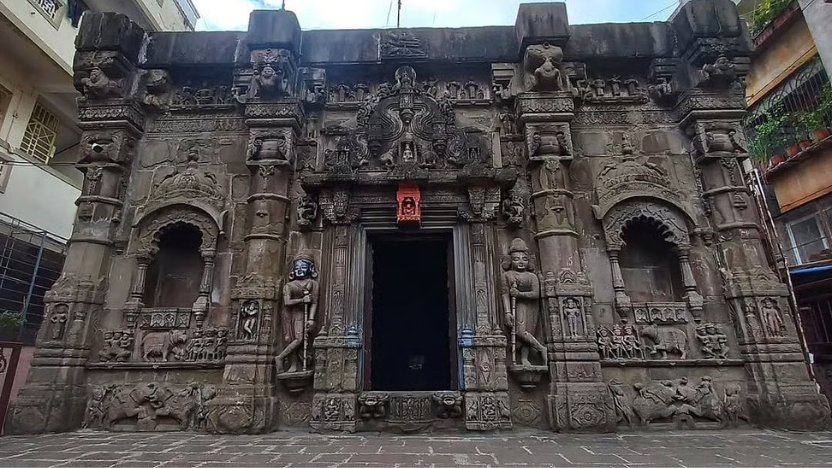
So sacred is this temple that devotees traditionally begin their Ashtavinayak Yatra here and return to this shrine upon completing the pilgrimage, marking it as both the spiritual starting point and conclusion of the journey.
Historically, the temple served multiple purposes during the 18th century. Beyond being a place of worship, it functioned as a samadhi temple and a centre for the practice of Hatha Yoga. The two-level structure houses the samadhi of Bhimgirji Gosavi, adding to its spiritual gravitas. Interestingly, it is believed that the temple was originally intended to be dedicated to Lord Shiva, a fact subtly revealed through architectural elements such as the presence of Shiva lingas on the temple roof.
Constructed entirely of Deccan basalt stone, the temple features a rectangular plan with a facade reminiscent of ancient rock-cut cave temples. Its architecture reflects a harmonious blend of Rajasthani, Malwa, South Indian, and Maratha influences. The richly detailed sculptures adorning the temple walls depict animals such as elephants and chained rhinoceroses, mythical beings, guardian deities, and dramatic battle scenes. Among these carvings is a rare historical panel portraying the aftermath of the Battle of Plassey in 1757, featuring a British soldier and a chained rhinoceros, an extraordinary intersection of history and sacred art.
The idol of Lord Ganesha, carved from black basalt and adorned with precious gems, radiates divine presence. Within the temple, inscriptions in Sanskrit, Devanagari, and Persian can be found, alongside verses from the Bhagavad Gita, reflecting the cultural and spiritual inclusivity of the era.
Today, the Trishund Mayureshwar Ganpati Temple continues to draw devotees, historians, and seekers alike. Whether one approaches it with devotion, curiosity, or a love for heritage, this sacred shrine in Somwar Peth offers a rare and deeply enriching glimpse into Pune’s spiritual and historical legacy.
Source / Image Credit : PUNE PULSE , ABP Live - ABP News , Ancient Hindu , Sangbad Pratidin, Free Press Journal