
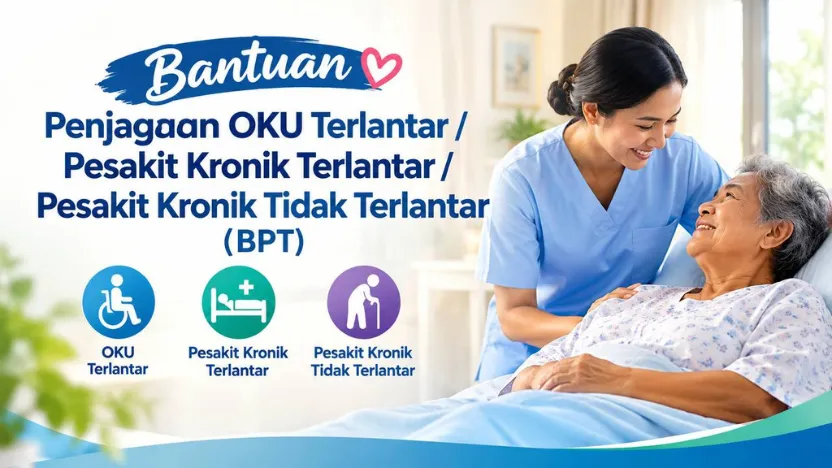
Caring for a family member who is bedridden, living with a disability or battling a chronic illness can be both emotionally and financially demanding. From daily necessities and medical needs to the time required for constant care, the responsibility can place considerable pressure on families.
To help ease this burden, the government has announced an increase in the monthly Bantuan Penjagaan OKU Terlantar (BPT) allowance from RM500 to RM600 under Budget 2027.
Prime Minister Datuk Seri Anwar Ibrahim announced the measure when presenting the budget in the Dewan Rakyat on October 9, 2026. The increase will provide an additional RM100 a month for eligible recipients, offering further financial support to families and caregivers looking after people who need ongoing assistance.
The announcement forms part of the government's broader efforts to strengthen support for persons with disabilities and vulnerable communities. According to the official Budget 2027 speech, the overall allocation for disability assistance will increase to RM1.5 billion, benefiting more than 300,000 people.
Here is what you need to know about the BPT allowance, who may qualify and how to apply.
What is the Bantuan Penjagaan OKU Terlantar (BPT) ?
The Bantuan Penjagaan OKU Terlantar (BPT) is a monthly financial assistance programme administered by the Department of Social Welfare, also known as Jabatan Kebajikan Masyarakat (JKM).
The assistance is intended to ease the financial burden on families and caregivers who look after bedridden persons with disabilities (OKU), bedridden patients with chronic illnesses and certain patients with chronic illnesses who require continuous treatment.
In eligible circumstances, assistance may be paid in the patient's own name, including when a bedridden person has no caregiver or their caregiver is not a Malaysian citizen.
The programme recognises the important role families play in caring for loved ones at home. The financial assistance is intended to help cover basic needs and support their continued care within the community.
Under Budget 2027, the monthly rate is set to rise from RM500 to RM600. Until the new rate takes effect, applicants should check the latest payment arrangements with JKM.
Who is eligible for the BPT allowance?
According to the government's official information on BPT, applicants must meet the relevant citizenship, residency, household income and care-related requirements.
The main eligibility conditions are as follows:
1. Malaysian citizenship and residency
Applicants must be Malaysian citizens residing in Malaysia.
2. Eligible applicant categories
The application must fall under one of the following categories:
- A caregiver providing intensive care to a bedridden person with a disability or a bedridden patient with a chronic illness.
- A patient with a chronic illness who is not bedridden but requires continuous treatment for at least three months. The application may be considered under the patient's own name.
- A bedridden person with a disability or a bedridden chronic illness patient who has no caregiver, or whose caregiver is not a Malaysian citizen. In these circumstances, the assistance may be provided in the patient's own name.
3. Household income
The total monthly household income must not exceed RM5,000. Meeting these conditions does not automatically guarantee approval, as applications remain subject to JKM's assessment and verification.
How to apply for the BPT allowance?
Eligible caregivers and patients can apply through their nearest District Social Welfare Office or use the application channels provided by JKM.
Here are the steps to follow.
Step 1: Check your eligibility
Before applying, make sure you meet the citizenship, residency, household income and relevant care requirements.
If you are applying on behalf of a family member, check which applicant category applies to your circumstances.
Step 2: Prepare the supporting documents
Applicants should prepare the relevant documents to help JKM assess their application. These may include:
- Applicant's MyKad: Copies of the front and back.
- Identification documents of household members: Copies of MyKad, MyKid or birth certificates for family members living in the same household.
- OKU card or temporary registration slip: Where applicable.
- Proof of household income: An income statement, an employer's confirmation letter or a declaration of income, where relevant.
- Medical confirmation: Relevant medical reports or confirmation of the patient's condition and care requirements.
- Proof of address: A copy of a utility bill, such as an electricity, water, telephone or Astro bill, or other address verification accepted by JKM.
- Supporting documents for special circumstances: Death or divorce certificates and other relevant reports, where applicable.
The documents required may differ depending on the applicant's circumstances. It is advisable to contact the relevant District Social Welfare Office before submitting an application to confirm the latest requirements.
Step 3: Contact your nearest JKM office
Visit or contact your nearest District Social Welfare Office to obtain the latest application forms and instructions.
You can also refer to the official JKM website at (https://www.jkm.gov.my) for information about monthly welfare assistance and application procedures.
Step 4: Submit your application
Complete the relevant application form and submit it with the required supporting documents through the channel specified by JKM.
If you apply online, take note of the follow-up requirements provided by the system. Applicants should confirm whether they need to attend the relevant District Social Welfare Office within 14 days of submitting their application, as missing a required appointment or verification step may affect the application.
Why this assistance matters to caregivers?
For families caring for a bedridden loved one, even a modest increase in monthly assistance can help with everyday expenses.
Caregiving may involve buying essential supplies, managing transport to medical appointments and providing support throughout the day. Some caregivers may also need to reduce their working hours or leave employment to look after a family member.
The proposed increase from RM500 to RM600 a month offers additional support to eligible households and acknowledges the responsibilities carried by those providing care.
While financial assistance cannot remove every challenge associated with long-term caregiving, it can help families manage some of the costs and continue supporting their loved ones at home.
Where to get more information?
For the latest eligibility criteria, application procedures and payment updates, contact your nearest District Social Welfare Office or visit the official JKM website.
Applicants should confirm the implementation date of the revised RM600 monthly rate with JKM, as the increase was announced under Budget 2027.
For caregivers who spend their days looking after someone they love, access to the right assistance can make a meaningful difference in managing the demands of care.
Source : Bernama
Image Credit : newswav
You may be interested in

Ethnic Retro Corful Peacock Jhumka Earrings Womens Indian Jewelry Flower Gold Bell Tassel White Pearl Earrings

Ready stock lotus design indian saree

Royal Heritage Embroidered Anarkali Gown for Women | Premium Festive Wear by RANGOLI BAZAAR

Indian Wedding Forehead Netti Pattam & Hand Wrist Pattam Gold Plated Traditional Bridal Ceremony Set