She grew up watching people in Bukit Jalil Estate collect water directly from the river and boil it over the stove before drinking it. To a child, it was part of everyday life. But for Dr M Yamunathevi, one question stayed with her.
“There must be a better way to treat this water.”
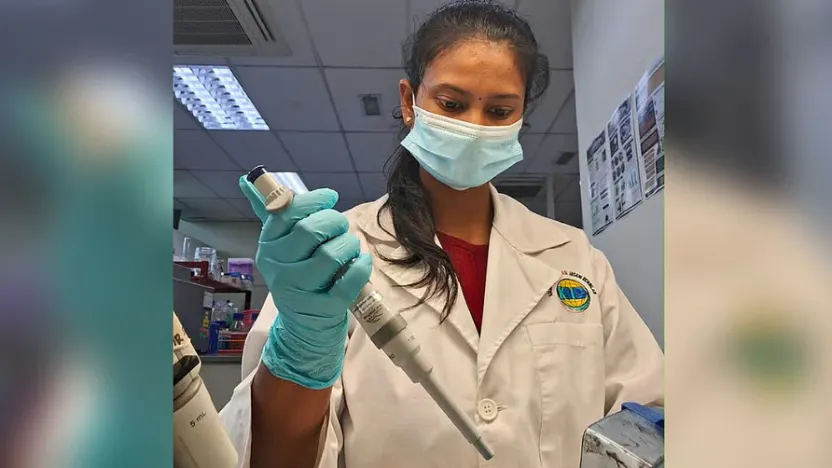
Years later, that childhood thought would take her from the estate she grew up into the laboratory, and eventually to a PhD in Bioscience, specialising in Environmental Biotechnology, from Universiti Teknologi Malaysia (UTM).
At just 27, Yamunathevi completed her doctorate in August 2025. Her research focused on wastewater treatment using bacterial-nanocellulose-based technology, exploring a more sustainable way of removing pollutants such as copper from water. For Yamunathevi, however, her research was never just about experiments, laboratory equipment or scientific papers. It was personal.
“Growing up in the estate made environmental issues feel very real to me, particularly the importance of safe water,” she says.
“I carried both my father’s values and my community’s experiences into the laboratory.”
Yamunathevi is the first person in her family, and among the first from the Bukit Jalil Estate community, to achieve a doctorate. Her journey did not begin with privilege or a clear academic roadmap.
Her father, S Mathivanan, grew up in a modest environment where education was considered one of the most important investments a family could make. He attended nursery from the age of three and started school at seven. He also went for tuition classes that cost just RM2 a session with a teacher named Balan near the Bukit Jalil shops.
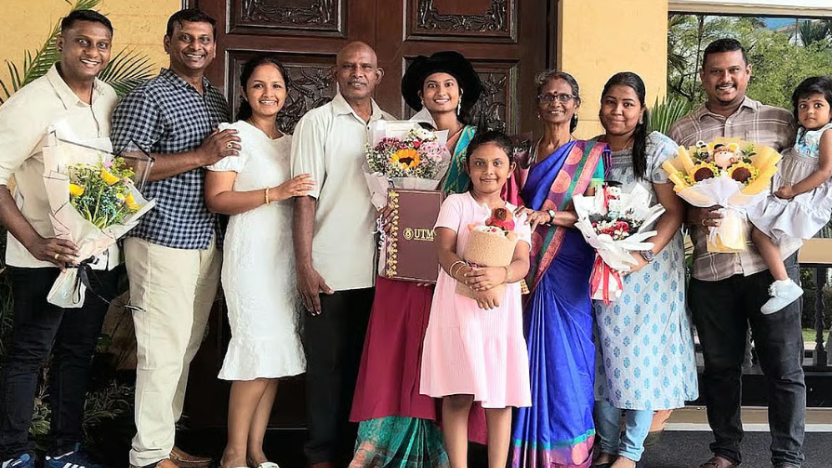
His childhood was otherwise simple, gardening with his father, playing football with friends and spending time in prayer. But his family never compromised when it came to education. That same belief followed him when he became a father. Mathivanan worked overtime whenever he could and made sure his children attended tuition, even when it meant rushing back to work afterwards.
He quietly carried the financial responsibility of giving his daughter the same opportunities as her three brothers. For him, it was what a father was supposed to do and for Yamunathevi, those sacrifices became something she wanted to honour.
“I always felt that one of the ways I could repay him was by making him proud,” she says.
“It was never only about getting a PhD or having a title. I wanted him to be able to look at what I have achieved and feel that all those years of hard work were worth it.”
Being the first in her family to pursue a doctorate came with its own challenges. There was no one at home who could fully explain what a PhD journey would look like, the failed experiments, confusing results, endless revisions, deadlines and moments of self-doubt. There were times when Yamunathevi questioned whether she was making any progress at all. But she learned to take the journey one step at a time.
“I did not need to have everything figured out at once,” she says. “I just needed to keep moving forward.”
While some of her friends were entering the workforce, travelling and enjoying their newfound independence, she was spending long hours in the laboratory. Not every experiment worked, some failed repeatedly.
There were tears, frustration and moments when she wondered whether she could complete the journey. But she kept coming back to the reason she had started. She was not trying to compete with anyone. She wanted to keep a promise she had made to herself.
Today, Yamunathevi sees her doctorate as more than a qualification. For her, it is also proof that a person’s starting point does not have to determine their destination.
“I did not come from a family of academics. I did not grow up already knowing how the research world worked,” she says.
“I had a goal, and I kept working towards it. If someone reads my story and thinks, ‘Maybe I can do this too,’ then I feel my journey has achieved something beyond the PhD itself.”
And that is the message she hopes reaches young people growing up in estates and modest communities. She wants them to dream beyond the limitations they see around them.
“Do not allow your background to decide the size of your dreams.”
You may not have the same resources, connections or opportunities as someone else, she says, but that does not mean you cannot achieve something extraordinary.
Her father has a message too, especially for parents. Encourage your children to aim high, he says, but never compare them with other students or make them feel that they are not good enough. Every child has a different journey. Give them education, discipline, encouragement and confidence, and they may go much further than anyone expects.
What comes next for Dr Yamunathevi?
Nearly a year after completing her PhD, Yamunathevi is now looking for opportunities to continue her academic journey, particularly as a lecturer at a public university. She hopes to continue her research while teaching and inspiring the next generation of scientists. And perhaps that is where her story comes full circle.
The little girl who once looked at the water her community was drinking and wondered if there could be a better way eventually found herself in a laboratory searching for exactly that answer. Her journey is not simply about becoming Dr Yamunathevi at 27.
It is about a daughter who wanted to make her father proud, a young woman who refused to let her circumstances define her, and a child from an estate who dared to believe that a bigger future was possible.
For every student who feels that their background is holding them back, her story carries a reminder: You may not get to choose where you begin, but you can choose how far you are willing to go.
Source : FMT
You may be interested in
Ethnic Retro Corful Peacock Jhumka Earrings Womens Indian Jewelry Flower Gold Bell Tassel White Pearl Earrings

Indian Wedding Forehead Netti Pattam & Hand Wrist Pattam Gold Plated Traditional Bridal Ceremony Set

Bollywood Style 1 Pair Of Earrings + 1 Necklace Vintage Jewelry Set Retro Design Inlaid Gemstone Match Daily Outfits Party Accessories
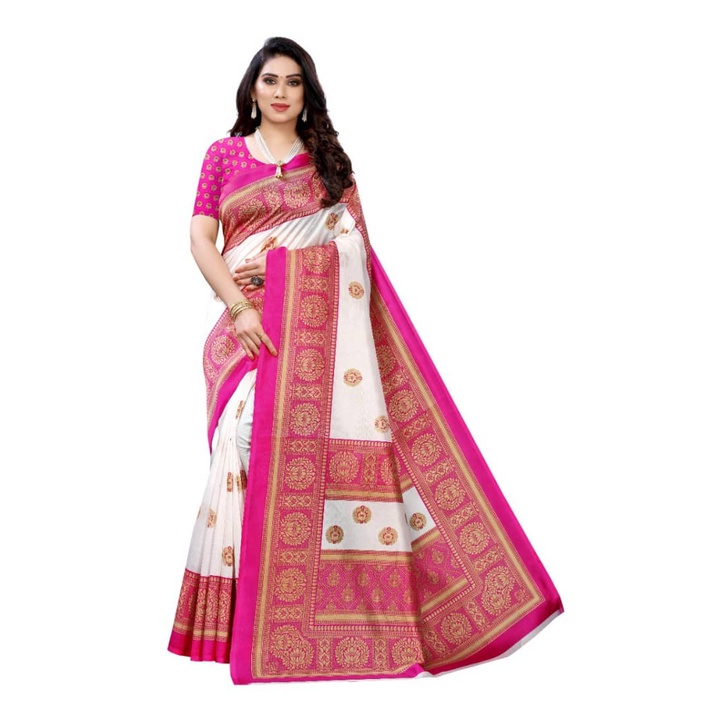
Ready stock lotus design indian saree