


Director H. Vinoth does not mind being called restless. In fact, he wears it almost like a badge of honour. Long before cinema found him, Vinoth had already lived several lives, never staying in one job for more than six months. For him, work stopped being meaningful the moment learning ended. “After six months, all you do is compete with colleagues,” he once said, explaining why he kept moving, searching, and questioning.
That restlessness would eventually shape the filmmaker he is today, the man now steering Jana Nayagan, a film that carries both cinematic weight and emotional expectation, as it marks a defining phase in Vijay’s journey.
Born in Chinnapallikuppam village, Vinoth’s earliest connection to storytelling came not from cinema halls but from printed pages. His father, a farmer and clerk at the Cooperative Society, would travel 40 kilometres to Vellore and return with magazines such as India Today and Mutharam. Vinoth devoured them. He also found joy in the village women’s collections of Maalaimadhi, Rani Muthu and other magazines. Later came writers like Rajesh Kumar and Balakumaran, quietly shaping his imagination.
Unlike many filmmakers, Vinoth did not grow up obsessed with movies. Watching a film itself was an event, a festival that required travelling long distances, returning before nightfall, and waiting for rare Tamil films on Doordarshan. Cinema entered his life slowly, almost hesitantly.
When he moved to Chennai, Vinoth continued working various jobs, often surrounded by wires, circuits and spare parts as an electrician and service technician. Yet, somewhere along the way, storytelling began to call him back. In 2003, at the age of 21, he decided to write. He penned one-page stories, sent them out, received no responses not even rejections. But with what he calls “blind confidence,” he decided to enter cinema.
The journey was anything but smooth. He sought out directors’ addresses from newspapers, worked briefly as a personal assistant to R. Parthiepan, and assisted on Pachchai Kuthirai. Soon, reality struck. “I realised I had come without any knowledge. I didn’t know what was happening on set,” Vinoth admitted. Disheartened, he stepped away from the industry.
But cinema, like an unfinished circuit, pulled him back. He reconnected through conversations, friendships, and eventually met director Raju Murugan. The 18 months he spent with him became a turning point. “Spend six months with him and your life will change,” Vinoth says, calling it one of the most valuable learning phases of his life. A brief stint as an assistant director on Goli Soda followed, where he worked on the Koyambedu market portions grounding his understanding of realism and space.
The spark finally found its outlet when Vijay Milton mentioned that Vijay Antony was looking for a script. That script became Sathuranga Vettai. Backed by actor-producer Manobala and supported by cinematographer-actor Natty, Vinoth made his directorial debut in 2014. The film’s moral compass about a conman realising what truly matters, immediately set Vinoth apart.
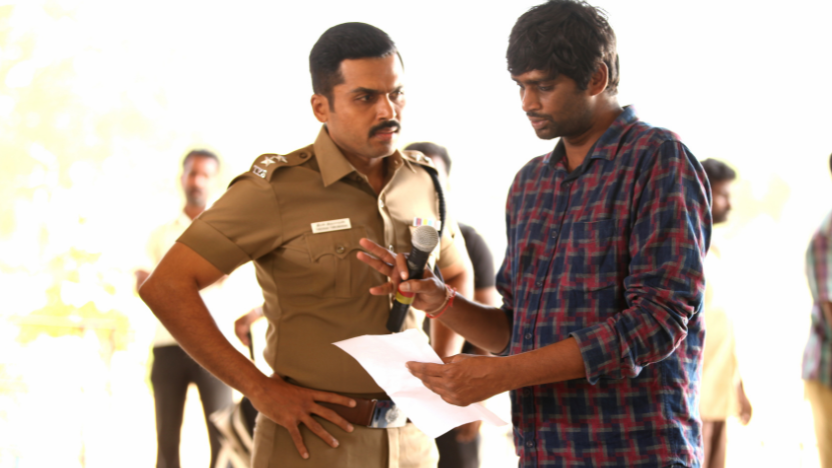
That moral questioning continued in Theeran Adhigaaram Ondru, his collaboration with Karthi, which went on to become one of the biggest blockbusters of the year. The seed of Theeran was planted years earlier, when Vinoth read a newspaper clipping about a brutal crime. He wrote a short story and filed it away. Nearly a decade later, the same incident resurfaced in a newspaper column, pushing him to revisit his old writing. With the help of journalists, police officers, and extensive research into India’s criminal tribes, Vinoth shaped a gripping narrative rooted in reality and human conscience.

For Vinoth, morality is never absolute. “A moral can be wrong too,” he believes. “In that case, we must break it but also provide a solution for what follows.” His films raise questions rather than offer sermons, mirroring the complexities of real life.
Despite the seriousness of his themes, humour quietly runs through his work. From Sathuranga Vettai to moments in Theeran, Vinoth believes cinema must engage audiences. “A film must run. It must make money,” he says candidly, adding that he does not view himself as driven purely by cinematic passion. Commercial choices, including romance and songs, are for him not compromises but necessities, ways to sustain the ecosystem that allows stories to be told.
He admires filmmakers like Thiagarajan Kumararaja for their clarity of vision and hopes to reach that space someday. Until then, Vinoth avoids watching his own films in theatres, fearing that audience reactions might influence his creative instincts. Instead, he watches the works of others such as Mysskin, Vetri Maaran, Martin Scorsese.
Now, with Jana Nayagan, Vinoth finds himself at another defining juncture. During his speech, he addressed speculation surrounding the film, firmly stating that it is neither a complete nor partial remake, calling it a “100 percent Thalapathy Vijay film.” He also urged audiences not to view this phase of Vijay’s journey as an ending, but as a beginning.
By dismissing rumours linking the film to Bhagavanth Kesari, Vinoth reinforced his belief in originality, even when inspiration or templates exist. For him, what matters is the intention, the question raised, and the honesty of execution.
The boy who once dusted off forgotten files and chased stories through newspapers now stands behind a film that carries the weight of expectation, legacy, and transition. In Theeran, Vinoth once said the scene of a young officer saluting the hero reflected him. Perhaps Jana Nayagan is another such salute to the journey, to the people, and to the restless mind that never stopped learning.
Source : SilverscreenIndia , Reddit , The News Minute , IMDb