

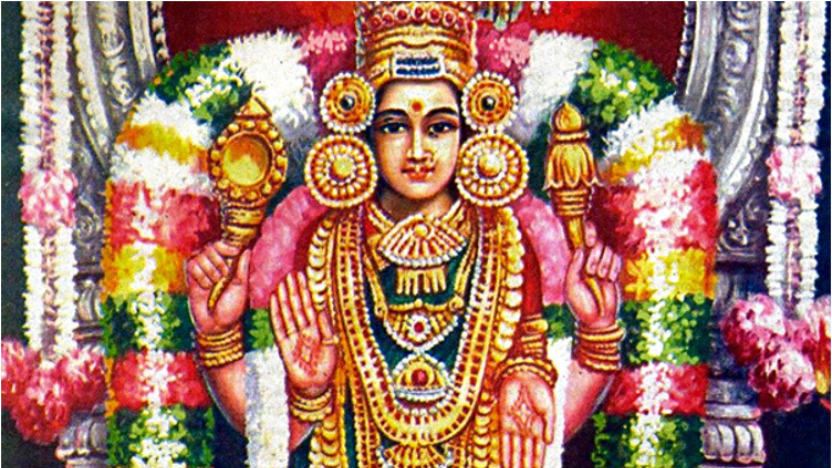
Among the many inspiring stories found in Hindu spiritual tradition, the legend of Abhirami Bhattar and Goddess Abhirami remains one of the most beloved tales of devotion, faith and divine grace.
The story takes place in the sacred town of Thirukadaiyur in Tamil Nadu, home to the renowned Amritaghateswarar Temple dedicated to Lord Shiva and Goddess Abhirami.
Centuries ago, a devotee named Subramania Iyer lived in Thirukadaiyur. His devotion towards Goddess Abhirami was so deep that he constantly meditated upon her divine form.
To him, every woman represented the presence of the Divine Mother. Whenever he saw women in the town, he would offer flowers and bow before them, seeing only Goddess Abhirami in their forms.
Because of this unusual behaviour, many people misunderstood him and considered him mad. However, his heart remained completely absorbed in the Goddess.
The King's Question
One day, King Serfoji of Thanjavur visited the temple.
While everyone stood respectfully before the king, Subramania Iyer remained seated in deep meditation before Goddess Abhirami, unaware of everything happening around him.
The king became displeased and ordered his men to awaken him.
Wanting to test him, the king asked a simple question:
"What is today's lunar day? Is it Amavasya (New Moon) or Pournami (Full Moon)?"
At that moment, Subramania Iyer's eyes were fixed on the radiant face of Goddess Abhirami, which shone before him like a thousand full moons.
Without hesitation, he replied:
"Today is Pournami."
The crowd was shocked.
In reality, it was Amavasai, the night of the New Moon.
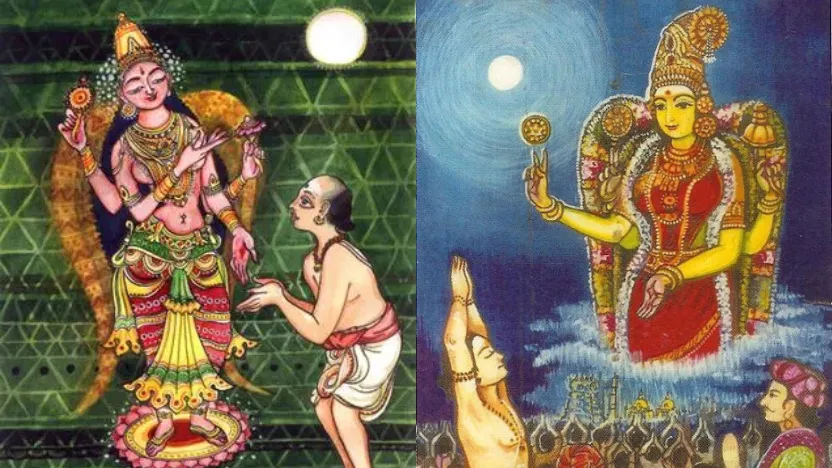
Angered by what appeared to be a false statement, the king ordered a severe punishment. A wooden platform was suspended above a blazing fire. Subramania Iyer was placed upon it and told that if the moon failed to appear by nightfall, he would be burned alive.
As darkness spread across the sky and the fire burned below him, the devotee remained calm. Instead of fear, he turned entirely towards the Goddess and began singing verses in her praise. These hymns later became the famous Abhirami Andhadhi.
The Miracle Of The Golden Earring
As Subramania Iyer reached the 79th verse of his hymn, Goddess Abhirami could no longer bear the suffering of her devotee.
Appearing in her divine form, she removed one of her golden earrings known as the Kanaka Thadanga and flung it into the night sky.
Instantly, the earring shone brilliantly like a full moon. The dark Amavasya night transformed into a radiant Pournami before the eyes of the king and the gathered crowd.
The miracle left everyone speechless. The king immediately realised the greatness of the devotee and sought his forgiveness.
From that day onwards, Subramania Iyer became known as "Abhirami Bhattar", the blessed devotee of Goddess Abhirami.
The Birth Of Abhirami Andhadhi
The 100 verses sung by Abhirami Bhattar came to be known as Abhirami Andhadhi. The word "Andhadhi" refers to a special style of Tamil poetry where the ending word of one verse becomes the beginning word of the next verse.
Even today, devotees recite Abhirami Andhadhi seeking divine grace, protection, wisdom and the fulfilment of seemingly impossible wishes.
The Deeper Symbolism of The Golden Earring
One of the most touching aspects of this story is Goddess Abhirami's willingness to part with her treasured golden earring to protect her devotee. In Hindu tradition, the Thadanga is closely associated with Goddess Parvati and symbolises divine beauty, strength and grace.
Yet, out of boundless compassion, the Goddess sacrificed her ornament to uphold the honour of her devotee. The story beautifully reminds devotees that sincere faith never goes unnoticed. When devotion is pure and unwavering, divine grace arrives even in the darkest moments, just as Goddess Abhirami turned a moonless night into a full moon to save her beloved child.
This version reads more like a spiritual feature story while maintaining the devotional essence and emotional impact of the original legend.
Source : jewelryinnarratives , Tamil and Vedas , Kulture Katha