


Arudra Darisanam is one of the most sacred observances in Shaivite tradition, celebrated during Dhanurmas on the Tiruvadhirai nakshatram, which is Lord Shiva’s own star. On this auspicious day, devotees worship Lord Shiva in His cosmic form as Nataraja, the divine dancer who awakens, sustains, dissolves, conceals, and liberates the universe through His eternal tandavam.
Observed this year on 3 January 2026, Arudra Darisanam is not merely a festival but a profound spiritual moment symbolising the cosmic dawn, the instant when consciousness emerges from stillness. It is believed that no other tithi carries the same depth of spiritual energy as this day, when Shiva dances the universe into awareness.
The highlight of Arudra Darisanam is the sacred Nataraja Abhishekam, accompanied by a unique naivedyam known as kaLi. This simple offering of rice flour and jaggery carries a deeply moving legend rooted in devotion and humility.
The story takes us to Chidambaram, where an ardent devotee named Sendan lived in extreme poverty. Despite having very little, he made it a daily practice to offer food to any Sivanadiyar who came to his doorstep. One morning, when a hungry devotee arrived, Sendan had nothing to offer except a small quantity of rice powder and jaggery. With sincerity and love, he prepared kaLi and served it.
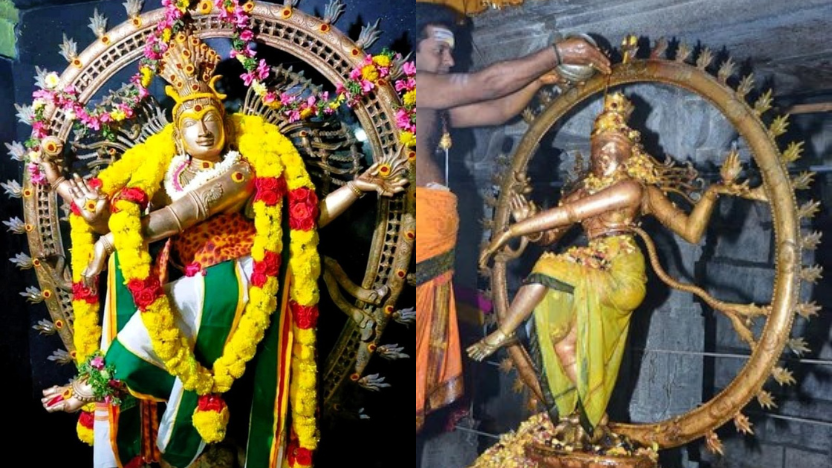
Unbeknownst to him, the guest was Lord Shiva Himself, who had come in disguise to test Sendan’s devotion. Pleased beyond measure, Shiva blessed him and left. The next morning, when the sanctum doors of the Chidambaram temple were opened, the priests were astonished to find traces of kaLi scattered inside the sanctum and even on the face of the Lord. A divine voice revealed that the offering was made by Sendan and instructed that kaLi should henceforth be offered as naivedyam on every Tiruvadhirai during Dhanurmas. From that day, Sendan came to be known as Sendanar, honoured eternally for his selfless devotion.
Arudra Darisanam also commemorates the day when Lord Nataraja performed the Ananda Tandavam at Chidambaram for His devoted sages, Vyagrapada and Patanjali. This divine dance represents the five eternal cosmic functions, creation, preservation, dissolution, illusion, and grace, encompassing the entire cycle of existence.
According to Tamil traditions, Shiva performed His tandavam in five sacred sabhas:
- Chidambaram – Ananda Tandavam (Gold)
- Madurai – Sandhya Tandavam (Silver)
- Thiruvilankadu – Urdhva Tandavam (Ruby)
- Tirunelveli – Tiru Tandavam (Copper)
- Kutralam – Tripura Tandavam (Art)
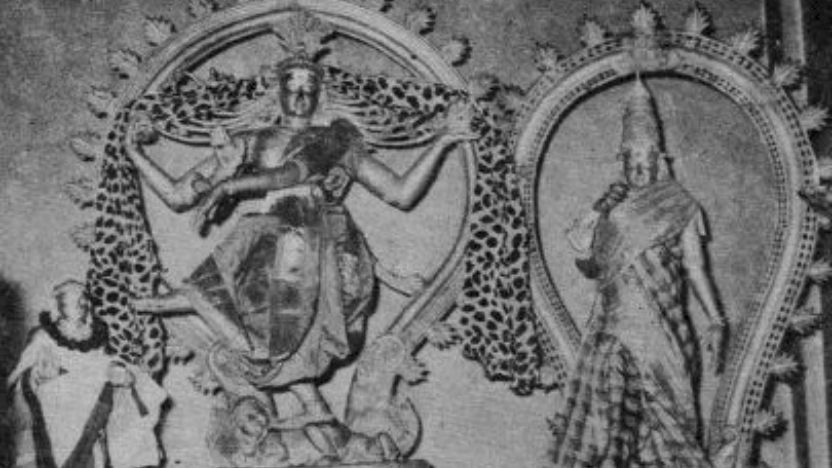
The Nataraja icon itself is a visual scripture. The flame in His hand signifies destruction and renewal, the drum represents creation, and the raised foot grants liberation. Beneath His feet lies Apasmara Purusha, the embodiment of ignorance and ego, reminding devotees that true freedom comes when ignorance is subdued.
Shiva, the formless Supreme Consciousness, manifests through countless forms as Nataraja the cosmic dancer, Ardhanareeswara the union of Shiva and Shakti, Dakshinamurthy the silent teacher, Vaidyanatha the divine healer, and Pashupati the protector of all beings. Through Arudra Darisanam, devotees are reminded of the eternal truth of Shivoham, that the worshipper and the worshipped are ultimately one.
Beyond theology, Nataraja symbolises art, culture, and rhythm itself. Every Bharatanatyam performance begins with reverence to Nataraja, acknowledging Him as the source of all movement, expression, and creativity.
Arudra Darisanam thus stands as a reminder that life itself is a divine dance, a balance of stillness and motion, destruction and creation, silence and sound.
May Lord Nataraja’s Ananda Tandavam awaken clarity, devotion, and grace within us all.
Image Credit : Jaya_Upadhyaya , LinkedIn , omarunachala , Templenet , sree krishnarpanam