


Melukat is one of Bali's oldest surviving purification traditions, and its roots stretch deep into the island’s spiritual and cultural history. Long before Bali became known for beaches, cafés, and souvenir streets, rituals like Melukat formed the very rhythm of Balinese life. These ceremonies, centred around sacred water, were believed to restore harmony between the physical world and the unseen forces that shape a person’s wellbeing.
The word melukat comes from the old Javanese term lukat, meaning “to cleanse” or “to purify.” Its origins can be traced to early Balinese Hindu practices that emphasised the role of water as a divine force. For centuries, Balinese communities have regarded natural springs, waterfalls, and rivers as living manifestations of purity, believed to carry the blessings of the gods. Over time, Melukat became a formal ritual performed to release leteh, or spiritual impurities, that accumulate through daily life.
Historically, the ceremony was performed during important phases of life before entering adulthood, after illness, or before major religious events. It was seen as a necessary step to maintain balance within the self and with the natural world. This reflects the Balinese understanding of sekala and niskala: the visible realm and the invisible realm, both of which must remain aligned for a person to feel whole. When this balance falters, individuals may feel mentally heavy, unlucky, or emotionally unsettled. Melukat was the traditional way to restore that harmony.
The philosophy behind the ritual also connects to Rwa Bhineda, the Balinese principle of duality. Just as day relies on night and joy exists alongside sorrow, spiritual purity must be constantly renewed. Melukat became the means through which people gently released the burdens of life whether emotional strain, troubling dreams, misfortune, or unexplained discomfort.
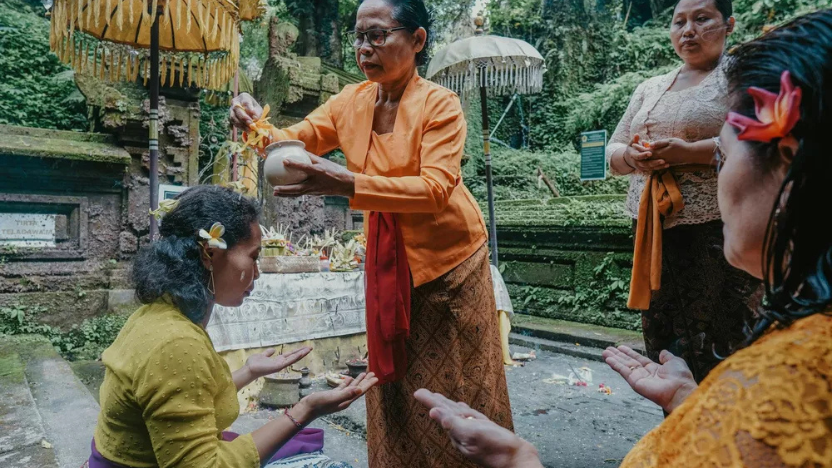
Though deeply ancient, the ritual has remained remarkably alive. Balinese families still visit sacred water sites regularly, twice a month for many, and at least every six months to cleanse their minds and hearts. Parents bring their children after periods of restlessness. Adults seek the ritual after heartbreak, loss, or major changes. Even when life proceeds smoothly, people undertake Melukat as a form of upkeep, a way to stay aligned with the world’s natural order.
The ceremony itself takes place at water sources considered holy for generations. Temples such as Tirta Empul in Tampaksiring have been places of purification since the 10th century, their waters fed by natural springs believed to be blessed by the gods. Other sites like Tirta Sudamala, Gunung Kawi Sebatu, and Dalem Pingit carry their own long histories as places of healing. Each one, whether grand or modest, is chosen for the power of its tirta, sacred water flowing from the earth with spiritual strength.
In recent years, as visitors have sought deeper connections beyond Bali’s tourist façade, Melukat has become a way for travellers to glimpse the island’s older soul. Participating under the guidance of a local priest offers an encounter with a tradition that has shaped Balinese identity for centuries. It is not an item to check off an itinerary, but a moment of stepping into the slow, sacred rhythm that has guided Balinese life for generations.
At its heart, Melukat remains what it has always been: a quiet ritual of cleansing, of release, and of realignment. A practice born from history, carried through families, and preserved in the flowing waters of Bali’s most sacred places.
Image Credit : Seek Sophie