


If one stands today at the foot of Batu Caves and looks up at the towering steps and the sacred hill beyond, one is also standing before the legacy of a man whose vision shaped Malaysian history in ways few realise.
Born in 1850 in Singapore, Thamboosamy Pillai was educated at Raffles Institution and rose to prominence through his work as an interpreter and later as an assistant to a senior legal practitioner. His professional duties eventually brought him to Selangor, where he observed the growing presence of South Indian migrants who had settled in the region.
Thamboosamy recognised the community’s need for a place of worship and initiated the construction of a small temple dedicated to Goddess Mariamman along a riverbank in Selangor. In 1875, as the Kuala Lumpur railway authorities sought to expand their goods yard, an alternative site was offered for the temple.
With the consent of the Sultan of Selangor, a modest attap-roofed temple was subsequently erected along Jalan Bandar, now known as Jalan Tun H.S. Lee. The Sultan formally decreed that the land on which the temple stood would be designated as land for the Indian community.
The story of Batu Caves as a sacred site begins with the visit to the site. When he later visited the limestone caves, he was struck by the shape of the main cave entrance, which resembled the VEL, Lord Murugan’s divine spear. Interpreting this as a sign, he resolved to dedicate the site to the deity.
In 1888, together with his friend Kanthapa Thevar, Thamboosamy placed a VEL inside the cave, marking the beginning of worship at Batu Caves. The first Thaipusam celebration followed the next year, laying the foundation for what would become one of the most significant Hindu pilgrimage sites outside India. By 1891, the Sri Subramaniar Swamy Temple was formally established, and a consecrated idol of Lord Murugan was later installed within the cave.
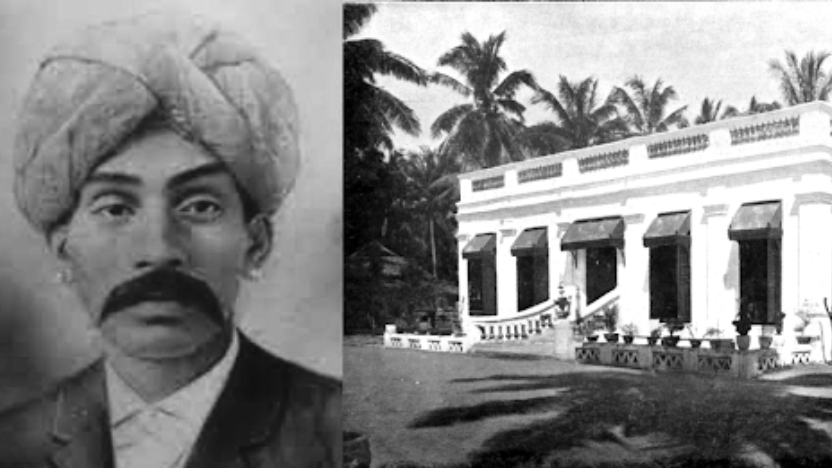
The journey was not without resistance. In 1916, British colonial authorities ordered the removal of the VEL and attempted to halt Hindu worship at the site. The temple committee challenged the decision in court and emerged victorious, securing the community’s right to continue religious practices at Batu Caves. Over time, access to the temple improved, with wooden steps installed in 1930 and replaced by concrete stairs in 1940. Today, the 272 steps, now famously painted in vibrant colours, lead millions of devotees and visitors to the temple each year. At the base of the hill stands the 140-foot statue of Lord Murugan, unveiled in 2006 and recognised as the tallest statue of the deity in the world.
In the 1870s, Thamboosamy moved to Klang and later Kuala Lumpur, where he rose through the colonial administration to become chief clerk at the Treasury and occasionally acted as State Treasurer. He was also appointed a Justice of the Peace, the first Indian to receive such recognition in Malaya.
Concerned about the growing Indian workforce brought in for railways and public works, Thamboosamy recognised the need for religious and cultural spaces. In 1873, he founded the Sri Mahamariamman Temple, initially near the Kuala Lumpur Railway Station. When the land was later reclaimed for railway use, the temple was relocated with the Sultan of Selangor’s consent to its present site on Jalan Tun H.S. Lee. The Sultan himself laid the foundation stone, formally allocating the land to the Indian community. Thamboosamy became the temple’s first chairperson, and though it began as a family shrine, it was eventually opened to the public.
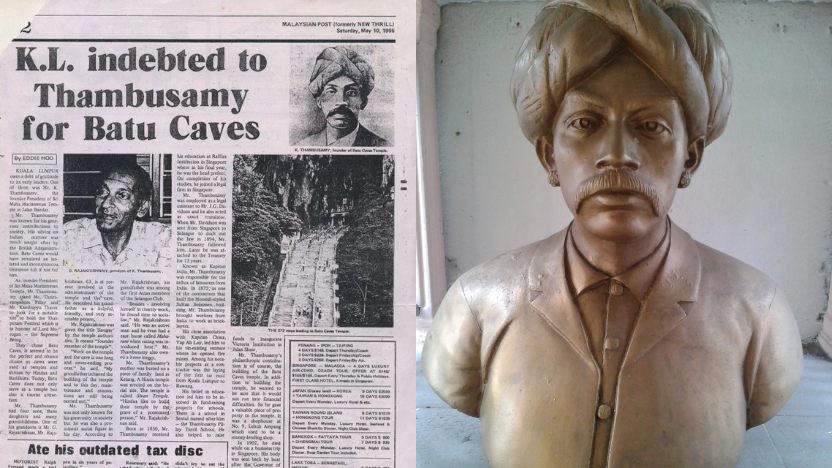
In the 1880s, Thamboosamy left government service and entered the mining industry, partnering with Chinese business magnate Loke Yew in Rawang. Their collaboration proved transformative. In 1894, they installed electric generators to power tin mining operations, making them the first to use electricity for mining in Malaya. This innovation extended to Rawang town, which became the first in the country to have electric street lighting. Thamboosamy later served on the Kuala Lumpur Electricity Board and played a role in supplying power to major institutions, including the Kuala Lumpur Railway Station.
A road builder as much as an industrialist, he contributed to the development of key routes connecting Kuala Lumpur, Rawang, and Kuala Kubu. His vision of progress was inclusive. Together with Sultan Abdul Samad, Yap Kwan Seng, and Loke Yew, he helped establish the Victoria Institution in 1894, providing English-medium education to boys in Kuala Lumpur and shaping generations of leaders.
He passed away in 1902 while in Singapore. His sons continued the family’s work, though much of his legacy now lives quietly in stone, roads, schools, power lines, and prayer. Raising a glass to a remarkable individual whose impact will be felt for generations.
Source / Image Credit : The Rakyat post , yusrinfaidz.blogspot , NST , Prestige Online , Saravana Kumar Purushotman