

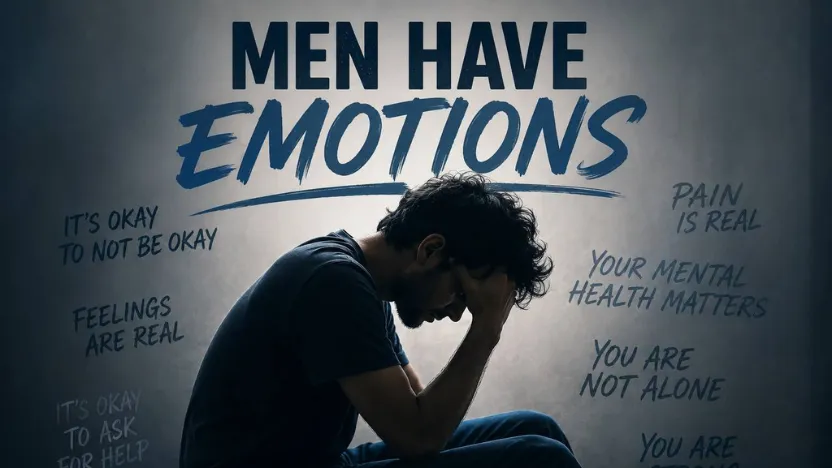
For years, conversations around mental health have rightly encouraged women to speak up, seek support and break free from emotional stigma. But somewhere along the way, another important truth has often been overlooked, men struggle too.
Mental health does not discriminate by gender, age or social status. Pain does not choose whether someone is male or female before it enters their life.
Yet many men continue to suffer silently because society has conditioned them to believe that vulnerability is weakness.
From a young age, many boys are taught phrases like “man up,” “be strong,” “don’t cry,” and “deal with it.” While often said casually, these words create emotional walls that can follow them into adulthood.
As a result, many men grow up believing that expressing sadness, fear, anxiety or emotional exhaustion makes them less of a man.
It does not.
Behind calm appearances and forced smiles, many men are quietly battling depression, loneliness, heartbreak, financial pressure, trauma, anxiety and emotional burnout.
Some carry the weight of being expected to provide for families while silently dealing with personal struggles. Others suffer through relationship breakdowns, rejection, isolation or failure with no safe space to express what they are feeling.
The painful reality is that many men only speak when their pain has become unbearable, and sometimes, by then, it is already too late.
This is why men’s mental health needs to be spoken about just as openly and seriously as women’s mental health.
Acknowledging men’s struggles does not take attention away from women’s experiences. Mental health is not a competition. Compassion should never be selective.
Creating safe spaces for men to speak openly is not about weakening masculinity. It is about redefining strength.
Real strength is not pretending to be okay when you are breaking inside. Real strength is having the courage to say, “I am struggling and I need help.”
Men deserve support. Men deserve understanding. Men deserve to cry without shame, to ask for help without judgment, and to heal without being told to simply “get over it.”
Because mental health has no gender. And every voice deserves to be heard.