


July 1, 1982 marked a significant moment in the political and social journey of modern Tamil Nadu. On that day, then Chief Minister M.G. Ramachandran sat down to share a meal with primary school children in Pappakurichi village of Tiruchirappalli district. This simple act signalled the formal launch of the Chief Minister’s Nutritious Noon Meal Scheme, a programme that would go on to shape the state’s welfare framework for decades.
The initiative was viewed through many lenses. To some politicians, it appeared to be a carefully calculated populist measure. Nutritionists saw it as a means to provide at least a third of a child’s daily nutritional requirement. Educationists recognised its potential to improve school enrolment and attendance. Others questioned its financial sustainability or pointed to the additional responsibilities it placed on teachers. For MGR, however, the scheme represented something far more personal, the assurance that no child would have to study on an empty stomach.
Reflecting on the programme, MGR once spoke about his own childhood experiences of hunger, recalling a time when survival depended on the kindness of a neighbour who shared a bowl of rice gruel. He believed that it was the faith of such compassionate women that had carried him to the position of Chief Minister. The thought of countless children across villages and hamlets receiving a nourishing meal and blessing those who made it possible, he said, brought him deep satisfaction.
While school meal programmes were not entirely new to Tamil Nadu having existed in various forms since the early 20th century, they were largely driven by individual philanthropy. It was K. Kamaraj who first envisioned the noon meal scheme as a structured public policy. Yet, due to financial constraints and administrative limitations, its reach remained restricted to rural primary schools, with an allocation of less than ₹6 crore in 1982.
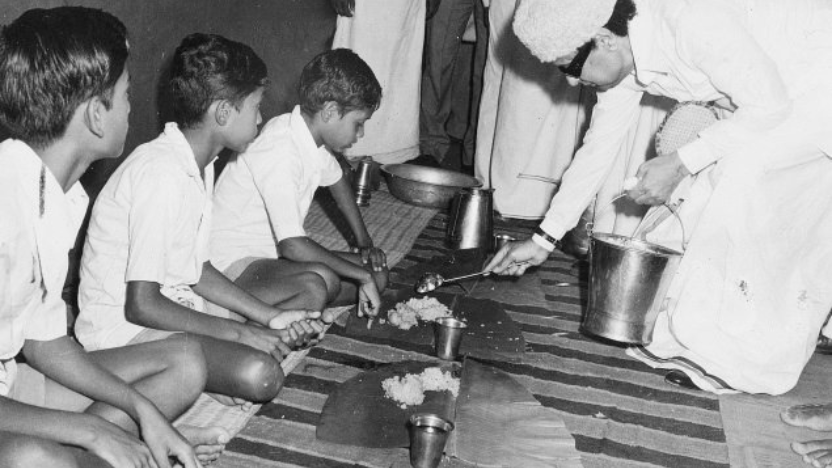
MGR’s approach marked a decisive shift. Despite scepticism and criticism, he pushed forward with determination, expanding the programme to an unprecedented scale.
The scheme initially covered 5.6 million children aged five to ten in rural schools and was extended to urban areas within two months, increasing the beneficiary count to 6.5 million. Balwadis were included to provide meals for children aged two to five, and the programme was later expanded to support the elderly, widows, and the destitute. Nearly 56,000 noon meal kitchens were established across the state, with the cost of a meal kept modest to ensure sustainability.
To ensure smooth execution, the scheme was closely monitored, with monthly reviews chaired by the Chief Minister and attended by senior ministers, officials, and key leaders during its early phase.
Criticism from the opposition persisted, often dismissing the programme as an unnecessary expense or a political gesture. Yet, MGR understood the quiet realities of hunger. Journalist Ragavendra Rao later recalled how even a few pieces of carrot or tomato in sambar rice were considered a luxury in many interior villages. His observation served as a reminder that, at the time, countless lives in Tamil Nadu were only a meal away from hardship and that the scheme addressed a need that went far beyond politics. improving lives affected by cancer.
Source / Image Credit : Times Of India , MGR