


A parent’s love is often described as unconditional, but sometimes, it grows far beyond blood ties and becomes a force that heals the world.
Born into poverty in Wardha, Maharashtra, Sindhutai’s life began with rejection. As an unwanted girl child, she faced constant neglect and discrimination, especially from her own mother. Education, something most children take for granted, was denied to her. Yet, her father quietly believed in her potential and secretly sent her to school, even as others expected her to spend her days grazing cattle.
But childhood was short-lived. At the age of 12, Sindhutai was forced into marriage with a man much older than her. What followed was a life filled with hardship, abuse and emotional pain. Despite her circumstances, she carried within her a quiet strength, one that pushed her to speak up for others. Even as a young girl, she stood against injustice, raising her voice for women who were being exploited around her.
That courage, however, came with consequences.
At just 20 years old, heavily pregnant, her life took a devastating turn. False accusations were spread about her, and without question, her husband chose to believe them. She was beaten mercilessly and abandoned, left alone to fend for herself. In a cowshed, injured and exhausted, she gave birth to her daughter with no support, no comfort, and no one by her side.
Hoping for refuge, she walked miles to her parents’ home, only to be rejected once again. With a newborn in her arms and nowhere to go, Sindhutai was forced onto the streets. She begged for food, slept in cemeteries and cowsheds, and lived each day in uncertainty, doing whatever it took to survive and protect her child.
Yet, in the midst of her suffering, something remarkable happened.
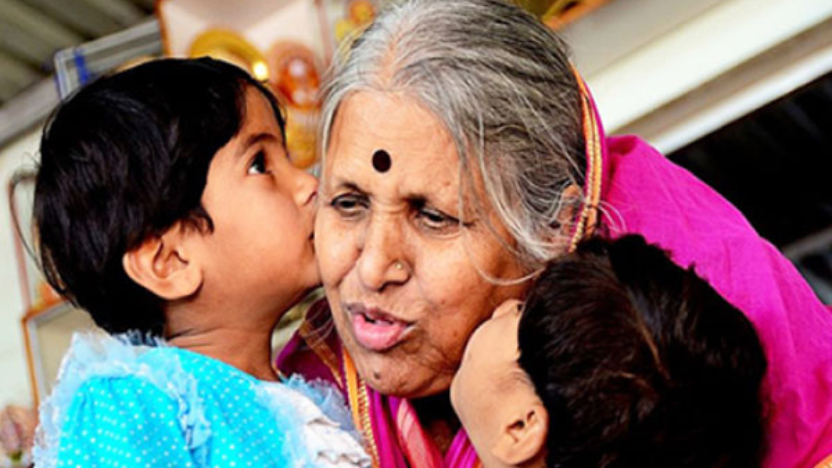
Instead of allowing her pain to consume her, she began noticing the silent suffering of others, orphaned children, abandoned and alone, much like she once felt. She saw herself in them. And slowly, despite having so little, she began to give.
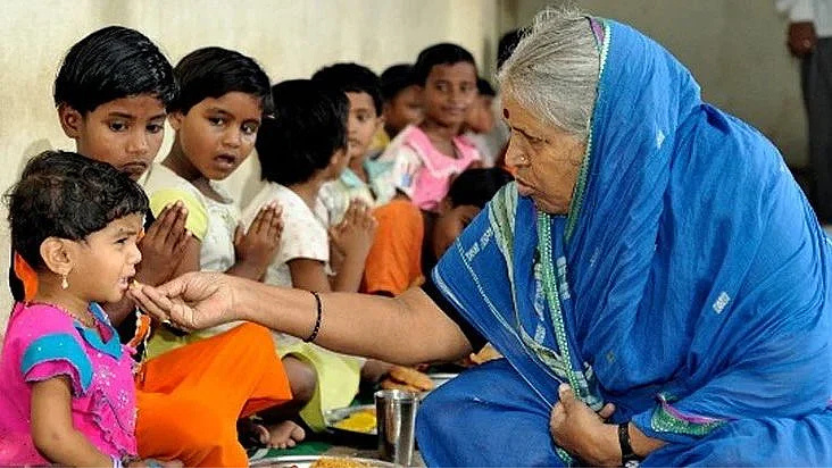
She started by taking in a few children, feeding them with whatever she could gather. Even if it meant begging more, she did not hesitate. What began as a small act of compassion soon grew into a lifelong mission. One child became many, and over time, Sindhutai became a mother to hundreds, then thousands.
Years of perseverance and the support of kind-hearted individuals helped her establish her first ashram in Chikaldara, Amravati. From there, her work expanded across Maharashtra. She founded multiple shelters and organisations, including the Savitribai Phule Girls’ Hostel, creating safe spaces where children could grow, learn and dream.
To her, they were never orphans. They were her children.
Many of them went on to build meaningful lives, becoming doctors, lawyers, teachers, contributing to society and carrying forward the love and values she gave them. Through them, her legacy continues to live on.
Her selfless service earned her recognition from across the world. She received more than 270 awards, including the prestigious Nari Shakti Award, presented by Ram Nath Kovind in 2017. Her inspiring journey was also brought to life through the Marathi film “Mee Sindhutai Sapkal.”
But beyond the awards and recognition, what truly defines Sindhutai is her spirit.
Life tested her in the harshest ways, through rejection, abuse and abandonment. Yet, she chose not to become bitter. Instead, she chose to love. Every fall only made her rise stronger, with a smile that carried both pain and purpose.
Her story reminds us that true strength is not just about surviving hardship, but about transforming it into something meaningful. She did not just rebuild her own life, she rebuilt the lives of thousands.
In a world that often feels broken, Sindhutai Sapkal became a source of healing. And through her journey, she teaches us that even the deepest wounds can give birth to the most beautiful forms of compassion.
Source / Image Credit : IndiaToday , sindhutaisapkal , The Quint