


In a quiet laboratory filled with experiments, patience and countless hours of research, a young Malaysian scientist is working on an innovation that could one day change how medical treatments are delivered around the world.
Her name is Keisheni Ganeson, a 31-year-old biotechnologist from Penang. With a deep passion for science and nature, she is developing a health innovation known as the Microneedle Patch, a tiny but powerful technology that may one day replace traditional injections.
For many people, the sight of a needle is enough to cause fear and anxiety. Keisheni hopes to change that. Her microneedle patch works like a simple plaster placed on the skin, but inside it contains microscopic needles that deliver medicine slowly and safely into the body.
The patch is made from biodegradable materials, meaning the tiny needles dissolve naturally after use. When applied to the skin, the microneedles gently penetrate the upper layer of the skin and release medication gradually. The process is designed to be almost painless, offering a safer and more comfortable alternative to conventional injections.
For patients who fear needles, elderly individuals, or those living far from medical facilities, such technology could make treatment much easier and more accessible.
What makes Keisheni’s research even more fascinating is the inspiration behind it, a humble natural flower.
Her innovation incorporates extracts from the butterfly pea flower (Sangu Poo), a vibrant blue flower widely known in Southeast Asia for its natural colour and medicinal potential. In Malay culture, it is known as bunga telang.
In her research, the butterfly pea extract is used to produce nanoparticles that can respond to changes in pH levels in the body. When the body experiences changes such as infection or inflammation, the flower’s natural compounds may react by changing colour.
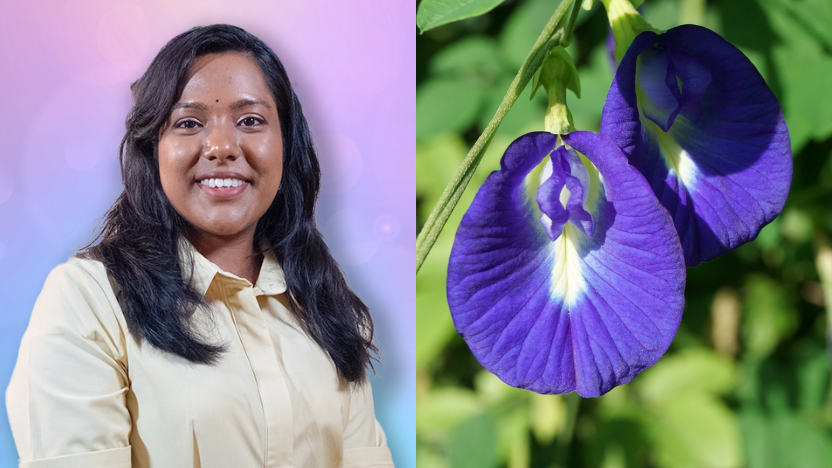
This unique property opens the possibility for the microneedle patch to act as a “smart” medical patch that could visually indicate changes in a wound or treatment condition.
Keisheni’s journey into this field began during her doctoral studies at Universiti Malaysia Terengganu, where she recently completed her PhD. Her research there focused on dissolvable microneedles designed for breast cancer treatment.
The biodegradable materials used in her study were derived from bacteria isolated in Malaysia, demonstrating how local natural resources can play a role in advanced medical innovation.
However, her interest in nature-based science started much earlier.
During her master’s research, Keisheni developed edible food packaging films made from natural ingredients such as aloe vera and cinnamon oil. That early experience sparked her fascination with combining modern biotechnology with natural materials, a philosophy that now defines her work today.
Beyond the laboratory, the potential impact of microneedle technology could be significant.
During the COVID-19 pandemic, millions of people around the world had to wait long hours or travel great distances just to receive a vaccine injection. Innovations like the Keisheni Microneedle Patch could one day allow certain treatments to be administered safely at home.
Such technology could also benefit elderly patients, individuals with disabilities, and communities in rural areas where hospitals and clinics are not easily accessible. By reducing the need for traditional injections, microneedle patches may also help ease congestion in healthcare facilities.
Keisheni’s work has already gained international recognition.
Her research has received several prestigious awards and grants, including the Merck Young Scientist Award and the Toray Science Foundation Grant. Her project has also been supported through the Merdeka Award Grant under the category of Outstanding Contribution to Science, Technology and Innovation 2025.
As part of her research journey, Keisheni will also have the opportunity to collaborate with leading global institutions, including University of Toronto in Canada, Imperial College London in the United Kingdom, and École Polytechnique Federale de Lausanne in Switzerland.
Through these experiences, she hopes to merge global scientific expertise with Malaysia’s natural resources to create healthcare innovations that can benefit communities everywhere.
But behind every scientific breakthrough lies a journey that is rarely easy.
Keisheni openly acknowledges that research often involves failed experiments, long nights in the laboratory, and the constant pressure to produce meaningful results. Progress in science can be slow and uncertain, but those challenges also build resilience, patience and determination.
Innovations like the Keisheni Microneedle Patch are not created overnight. They are the result of persistence, curiosity and countless attempts to solve complex problems.
Beyond her scientific achievements, Keisheni also hopes her journey will inspire more young women to pursue careers in science and technology.
She believes that women play a crucial role in research because they bring different perspectives that can lead to more inclusive and meaningful innovations. In particular, she highlights that research related to women’s health still receives limited global attention.
Encouraging more women to enter scientific fields, she says, will help ensure that future technologies are developed with broader perspectives and greater impact.
Today, the story of Keisheni Ganeson is more than just a story about science.
And perhaps one day, a tiny patch inspired by a blue flower will help transform how the world experiences medical treatment.
Source : Mooda , The Star , Keisheni Ganeson - 2025 , Merdeka Award