


Some might come across of this name, yet some may not. B.P. Nicholas’ story stands as an important chapter in Malaya’s early financial history. Arriving in the region around 1892, he received his early education in Singapore before beginning his career with the Federal Engineering Company. His diligence led to his appointment as the accountant of the Penang branch, a role that strengthened his understanding of business operations across the Malayan states.
After leaving the company, Nicholas ventured into entrepreneurship, partnering with Mr. Kock, a contractor from Ipoh, to establish one of the earliest financial service businesses serving expatriate Asians. Their work focused on savings and lending services that were scarce yet deeply needed at the time. Although the partnership eventually dissolved, Nicholas’ ambition remained unshaken.
He went on to launch his own business, B.P. Nicholas & Sons Bankers, at Mountbatten Road in Kuala Lumpur. With integrity and a reputation built on trust, he slowly expanded his enterprise. At every stage, he nurtured his sons within the business, training them from the ground up to ensure continuity and stability.
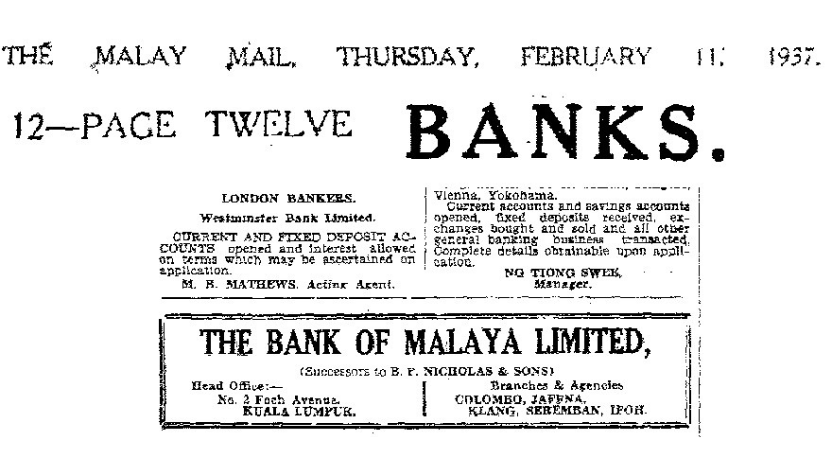
By 1936, his savings and lending operations including pawnbroking had grown strong enough to be formalised under statutory requirements. On 31 December 1936, he founded: The Bank of Malaya Limited, with an issued capital of $180,000. The bank held its first meeting on 9 January 1937, marking a historic moment: an Asian entrepreneur establishing a formal banking institution during the era of British colonial rule.
The bank became especially significant to the expatriate Ceylon Tamil community working in Malaya’s government and mercantile sectors. Nicholas earned their trust by ensuring safe and reliable remittances to families in Jaffna, Sri Lanka, a lifeline for countless households. To strengthen these services, he acquired the Bank of Jaffna in 1938, allowing seamless cross-border remittances at a time when such systems were rare.
Within its second year, the Bank of Malaya recorded a net profit of $16,085. However, British authorities later advised a name to change to avoid confusion with a potential reserve bank. In late 1938, it was renamed the Oriental Bank of Malaya Limited, a move that also reflected its expanding customer base.
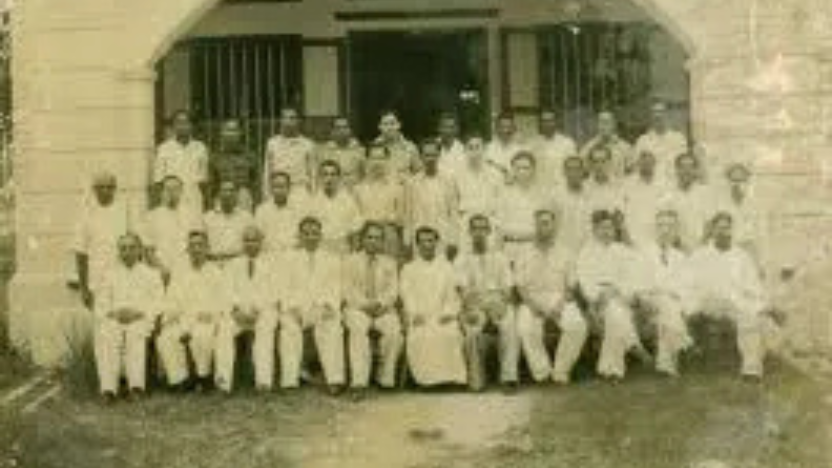
Nicholas earned respect across Malaya’s diverse communities, British officials, Malays, and Asians alike. His achievements were noteworthy enough to earn him a nine-line mention in the Who’s Who, a distinction seldom granted to Asians during colonial times. This recognition reflected both his integrity and his remarkable contributions to the region’s financial landscape.
As we remember a true pioneer of Malaysia, it's essential to acknowledge the legacy he leaves behind. Future generations may not recognise his name, but his influence will continue to inspire.
Source / Image Credit : The Story of the Oriental Bank