


Recently, many people have been discussing EIS on social media. Some are frustrated, while others are still unsure about what this system actually does. For context, the government introduced the Employment Insurance System (EIS), also known as the Employee Insurance System (SIP), in 2018.
Many workers feel dissatisfied because SIP contributions are deducted from their basic salary. In simple terms, besides EPF and SOCSO, a small amount is also deducted for SIP.
So, what exactly is EIS/SIP, and why does it matter? Here’s a simple breakdown:
The Employment Insurance Scheme (EIS), managed by PERKESO since January 2018, functions as a financial safety net for employees who lose their jobs. It provides temporary financial assistance to help individuals manage living expenses while searching for new employment. Beyond financial aid, EIS also offers career counselling, training opportunities, and job-matching support to help contributors return to the workforce more quickly.
Employers contribute a small monthly amount to sustain this protection, giving employees confidence that support is available if unexpected job loss occurs. As PERKESO also manages SOCSO, the system is widely trusted and reliable.
1. Why EIS/SIP Matters to Employers
Many employers assume EIS benefits only employees, but it also supports business stability in several ways.
Less Stress, Better Performance
When employees know they have financial support during job loss, they experience less anxiety. A stable and reassured workforce is typically more productive, committed, and loyal.
Smoother Layoff Process
Although difficult, layoffs sometimes happen. EIS provides financial support and job-search assistance to affected employees, making the transition easier for both parties.
Improved Company Reputation
Employees naturally gravitate toward companies that prioritise their well-being. Supporting EIS shows that your business values its workforce, helping you attract and retain strong talent.
A modest monthly contribution helps employers build a more secure, positive, and resilient workplace.
2. Who Needs to Contribute to EIS/SIP?
All private-sector employers in Malaysia must contribute to EIS, whether the business has one employee or a large workforce. The requirement applies to all private companies regardless of size or industry.
Who is exempt?
- Government employees
- Domestic workers, such as household helpers
- Self-employed individuals
Employee coverage begins at age 18 and ends at 59. Employees aged 57 and above who have never contributed do not need to start. Both employers and employees contribute monthly.
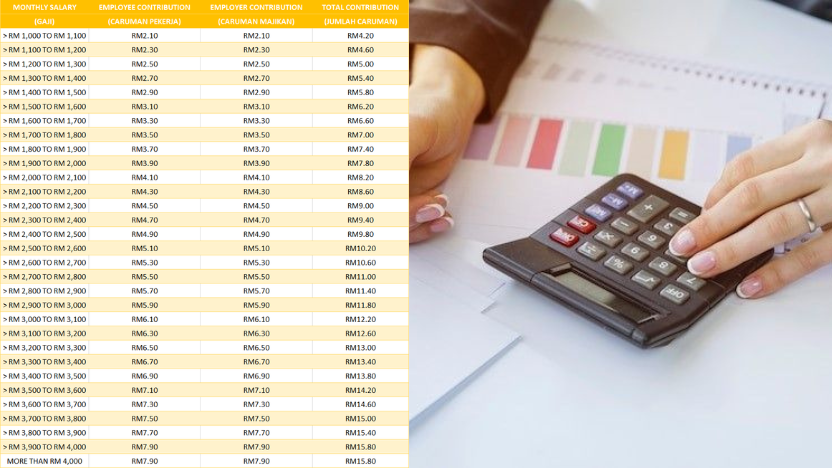
3. How Much Do You Pay for EIS/SIP?
EIS contributions are small and affordable. Employers and employees each contribute 0.2 percent of the employee’s monthly salary. This equals 40 sen for every RM100 earned.
Examples:
- Salary RM1,000 → Employer RM2, Employee RM2, Total RM4
- Salary RM3,000 → Employer RM5.90, Employee RM5.90, Total RM11.80
As of 1 October 2024, contributions are based on a maximum salary of RM6,000. Even if an employee earns more, the contribution is capped at RM11.90 from the employer and RM11.90 from the employee.
4. How to Register for EIS/SIP with PERKESO
Registering for EIS/SIP is a straightforward process.
1. Download the Necessary Forms
Visit the PERKESO website and download the following forms:
• SIP 1A and SIP 2A for most employees
• SIP 2 for new hires who have never contributed to PERKESO
2. Fill in Company and Employee Details
Provide employee names, IC numbers, and salary information.
3. Submit the Forms
- Submit the completed forms at any PERKESO branch. Online registration is not available at this time.
- For assistance, contact PERKESO at [[email protected]].
Once approved, the company can begin monthly contributions.
4. How to Pay EIS/SIP Contributions
Payments can be made through several convenient methods:
Internet Banking
Payroll systems can generate a bulk payment file that you upload directly to your bank. Contributions will update automatically.
PERKESO Assist Portal
- Log in, select “EIS – Contribution,” upload your payment file, and pay via FPX.
- FPX limits: RM1–RM30,000 (personal accounts) and RM2–RM1,000,000 (business accounts).
Electronic Funds Transfer (EFT)
Suitable for large payments. Contact PERKESO for account details.
Cheque or Money Order
- Payable to “Pertubuhan Keselamatan Sosial.”
- Include your company name, employer code, and payment period at the back.
Bank Counter
You may also pay at Maybank, RHB Bank, or Public Bank.
5. Penalties for Employers Who Do Not Contribute
Employers who fail to make required contributions may face significant penalties, including:
- A fine of up to RM10,000
- Imprisonment of up to two years
- Payment of outstanding contributions and late interest charges
@mashitahsedik Kena buang kerja based on 6 situasi ya. Dan make sure mencarum EIS sekurang-kurangnya minimum 12 bulan. Boleh refer playlist perkeso untuk lebih faham. #fyp #perkeso #hak #duit #pekerja #financialeducation #financialliteracy #socso #deduction #allowance #emp #eis #CapCut ♬ original sound - mashitahsedik - Cik Mashi
6. How to make a claim?
- Applications can be submitted online through the SOCSO portal by registering as a job seeker and uploading the required forms and documents.
- Once submitted, applications will be reviewed based on eligibility and contribution requirements.
- Approved cases will be verified by SOCSO/JTK/JPP before payment is processed and transferred directly into the applicant’s bank account.
7. What if someone refuses to contribute?
Employees who break the law and avoid contributing may face up to two years of imprisonment and a fine of up to RM10,000.
Source / Image Credit : Blog Kakitangan , qne.cloud